
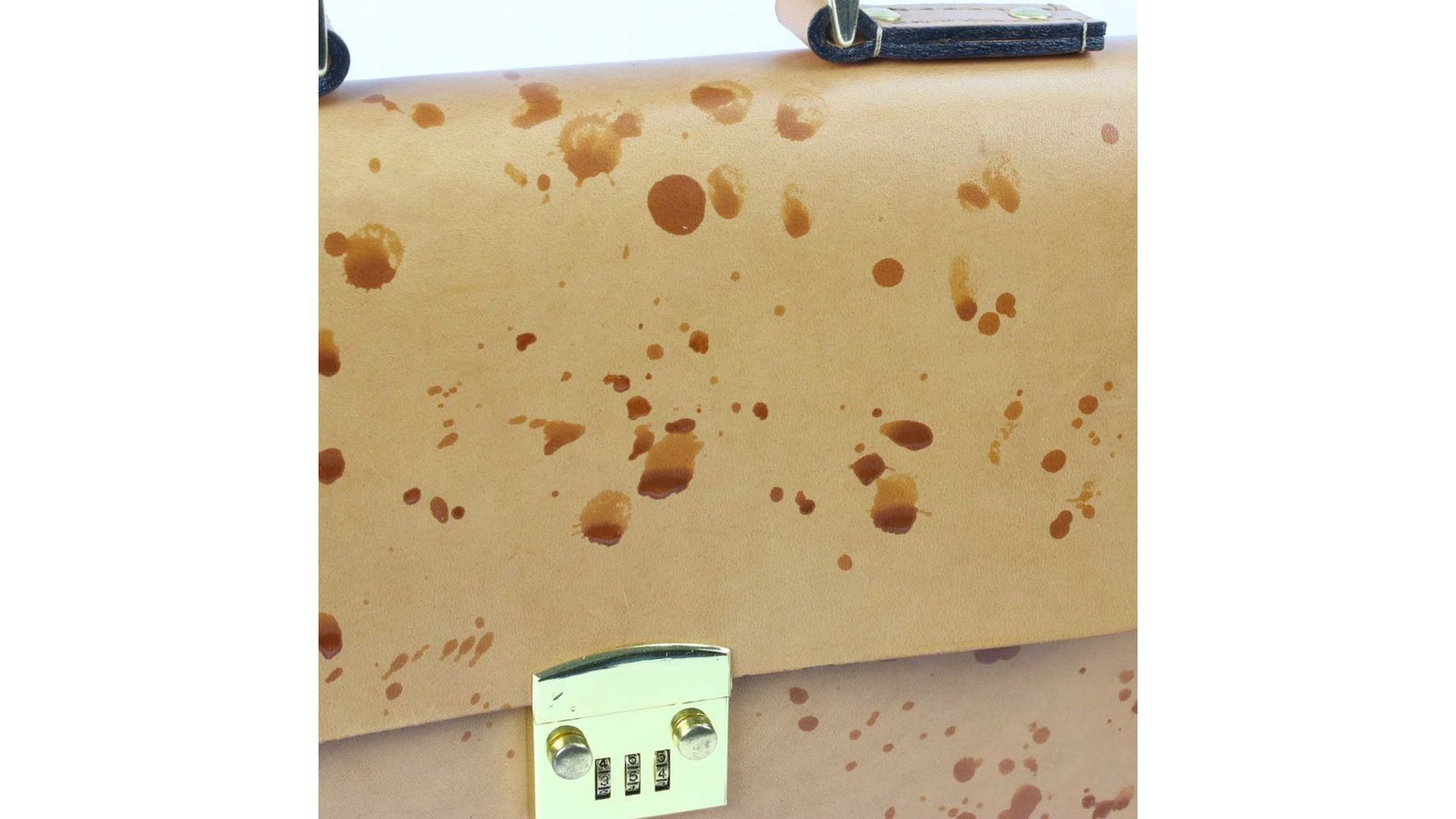
The photograph fills the frame with a pale, honey-colored flap and a spray of brown droplets. Some are round and crisp. Others have run into short streaks. A few sit in tight clusters, and one near the center has a darker rim than core. At the bottom, a brass combination lock sits square in the leather, with three number wheels. Near the top, the edge of a dark strap peeks in.

The file name calls it a rain test, and the result is visible at once: water marks natural leather.
The more useful question is what happens next.
What the leather is made of
Natural vegetable-tanned leather carries no dye and no heavy surface coating. The color in the photograph is the color of the tannins themselves. A reference entry on the material describes how the tanning happens in water-filled pits that become a tannic acid bath, with hides moved through stronger baths in turn (Leather Dictionary), with the hides moved through baths of rising strength.
Tannins are the key to the spots. They are water-soluble in part and they move. When a drop lands on the surface, it carries tannin and dissolved material with it as it soaks in and as it dries, and the area it touched ends up darker than its surroundings.
Why the edges of a spot look darker
Look at the larger droplets in the photograph. Several have a darker ring or lower edge. That is how a drying drop behaves: the liquid pulls toward its perimeter as it evaporates, taking dissolved material with it. The result is a thin border of concentrated color.
A reference entry on vegetable-tanned leather notes that the leather darkens by light, moisture and fat. A single water event is a small, local version of that same process.


What fades and what stays
Most of a fresh spot is temporary. A leather maker’s information page says that when vegetable-tanned leather meets water, the surface darkens for a time and most marks fade as it dries naturally (Dreesmann). A hobbyist thread on a rain experiment reports the same pattern in photographs: one forum poster photographed the spotting and then its fading back to the original color (forum thread). That source is a forum post and records one person’s observation, not a laboratory result.
Several things decide how much remains:
- Age of the leather. One retailer advises avoiding water in the first month, saying water rings appear much more easily on newer leather.
- Amount of water. A single drop leaves a mark; a soaking tends to darken the whole panel evenly, which can look better than a spray of spots.
- Prior oil or wax. Conditioning leather darkens it slightly. A retailer’s care page notes that doing it several times in a row can speed up the natural darkening process.
- Sunlight. The same page says undyed vegetable-tanned leather will tan or darken in sunlight.
Spots on an untreated flap, such as the one pictured, are the most visible case. The same droplets on a darker, dyed leather would barely register.
Drying it without damage
How the leather dries matters more than how it got wet. Two warnings recur in the sources:
- Do not use heat. A care page for veg-tan goods says to a care page warns against high heat such as a blow dryer, because the leather will shrink (Revival Cycles).
- Do not leave it wet. Another retailer’s page says another retailer says wet leather needs time to dry or it will mildew (Walnut Studiolo).
A forum contributor recounts a jacket hung in full summer sun and shrinking about two inches in the body. It is an anecdote, not a measurement, but it matches the manufacturer advice.
In practice: blot, stuff or support the shape, and let it dry slowly in room air away from a radiator or window.
Why the lock and strap look fine
The brass combination lock at the bottom of the frame shows no marks. Brass does not take the dark staining that leather does, and the lock sits flush in the flap. The dark strap at the top, finished and dyed, shows none of the spotting either.
That contrast is the point of the photograph. Finished leather carries a coating or a dye that hides the effect. Natural leather shows everything, and then settles.
Spots as record
Natural vegetable-tanned leather is not a material for people who want an unmarked surface for ever. A maker’s support page puts the attitude directly: the leather a maker’s support page frames that record as the bumps, scrapes, spills and spots of everyday life (Graf Lantz).
For a more detailed argument on the same idea, see the post on why patina is a record, not a flaw. For repairs on finished leather, the guide to fixing scratches and water spots on bridle leather covers the different case of a waxed, dyed surface.
Sources
- Leather Dictionary, Vegetable-tanned leather: https://www.leather-dictionary.com/index.php/Vegetable-tanned_leather
- Manuel Dreesmann, Vegetable Tanned Leather: https://www.manuel-dreesmann.com/blogs/information/vegetable-tanned-leather
- Revival Cycles, How to care for Veg Tan Leather Goods: https://revivalcycles.com/pages/veg-tan-leather-care
- Walnut Studiolo, Leather Care: https://blog.walnutstudiolo.com/pages/leather-care
- Graf Lantz, What is Veg Tan Leather: https://help.graflantz.com/en-US/what-is-veg-tan-leather-30296
- The Fedora Lounge, rain experiment thread (forum, anecdotal): https://www.thefedoralounge.com/threads/thurston-aero-vincenza-hh-rain-experiment.79698/post-1864841
- The Fedora Lounge, discussion of veg tan and rain (forum, anecdotal): https://www.thefedoralounge.com/goto/post?id=2861972
- Marcellino NY, Patina Is a Record, Not a Flaw: https://marcellinony.com/patina-is-a-record-not-a-flaw/
- Marcellino NY, Fixing Scratches and Water Spots on Bridle Leather: https://marcellinony.com/fix-scratches-water-spots-bridle-leather/


