
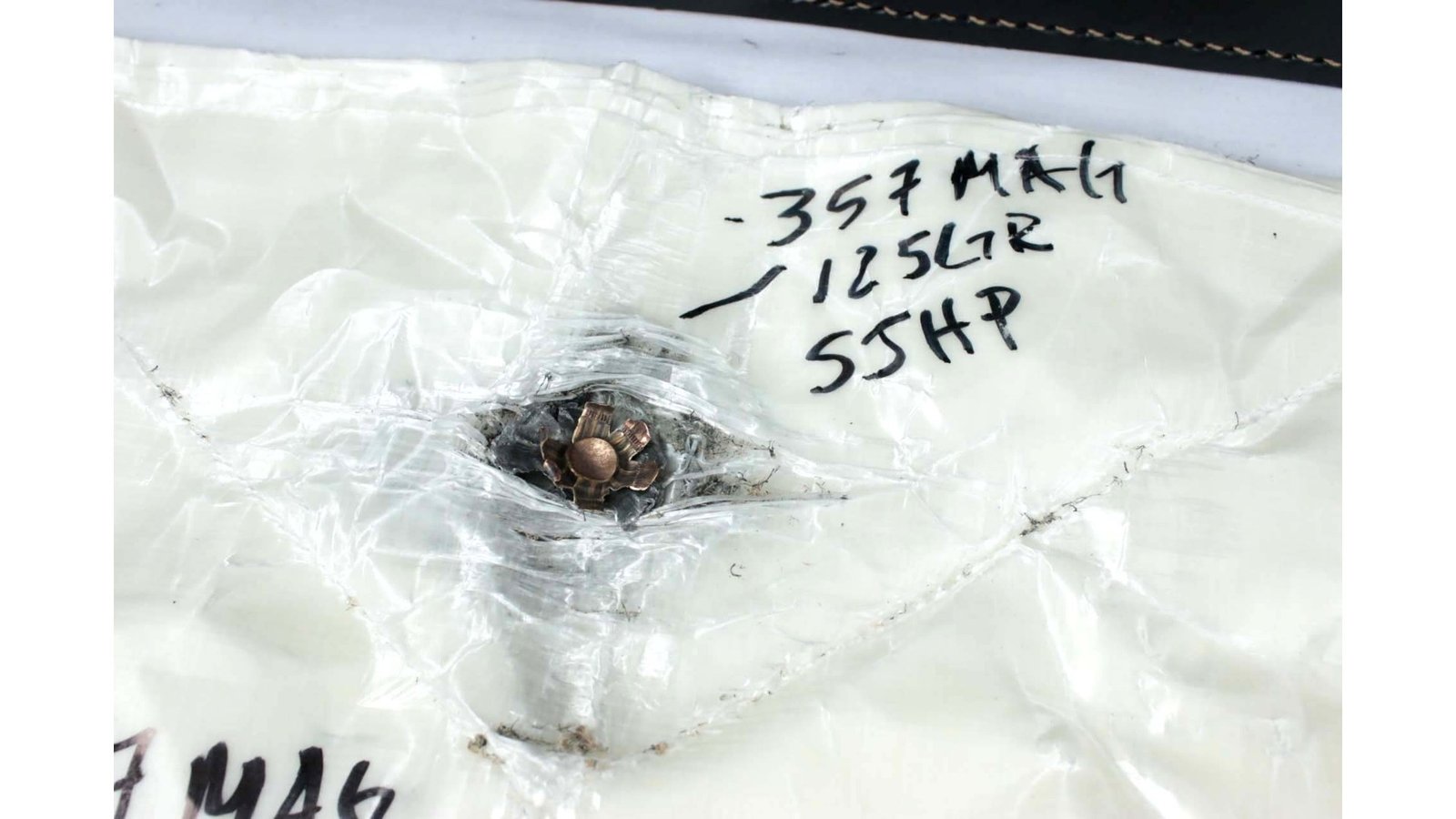
The photograph is blunt. A flattened copper-and-lead slug sits in the center of a white, creased sheet, its jacket peeled back like petals. Handwriting in black marker beside it gives the round: .357 Mag, 125 gr, and a hollow-point abbreviation that is hard to read. At the top of the frame, a strip of black leather with cream stitching shows what the fabric was made to sit inside.
Marcellino NY Briefcase Maker on YouTube: Marcellino leather briefcase bulletproof test #1.

The picture raises an obvious question for anyone considering a protective lining in a leather case. What does a rating such as NIJ IIIA promise?
The test behind the photograph
Marcellino NY built a bridle-leather briefcase with a Dyneema lining in 2015 and 2016. The maker’s own description of the first test says the pad stopped 9mm, .44 and .357 rounds, did not stop a very fast 9mm +P+ round, and let the first .357 through because it hit a cross-stitch line. The description adds that later pads would not carry cross-stitching.
That is an unusual thing for a maker to publish. Most product pages show the round that stopped. This one records the round that did not, and why. The finished product, described in the maker’s later video on the bulletproof bridle leather briefcase, is listed as rated NIJ IIIA, and the post on the MacArthur 1235 bulletproof bridle leather briefcase covers the product itself.
The ratings and what they mean sit with a public standard.
What NIJ Level IIIA is
The National Institute of Justice, part of the U.S. Department of Justice, publishes the standard that sets performance levels for body armor. Its 2008 version, Standard 0101.06, was written to set minimum performance requirements and test methods for personal body armor that protects the torso against gunfire (NIJ summary).
Under that version, armor was classed as IIA, II, IIIA, III or IV. A summary of the standard describes Type IIIA as tested with a .357 SIG 125-grain round near 1,470 feet per second (secondary summary), alongside a .44 Magnum round. A published compliance test report for an armor model lists the .44 Magnum as a 240-grain semi-jacketed hollow point at about 1,430 feet per second.
The round in the photograph, a .357 Magnum 125-grain, is not one of those named test rounds. That does not make the photograph meaningless; it shows how a fabric behaved against a round the maker chose. It does mean the photograph is evidence of a maker’s test, not a certification result.


The standard has been replaced
NIJ has since published Standard 0101.07, and it changes the names. The agency’s page for the new standard states that protection level nomenclature has been revised to be more descriptive of threats, and that the test threats now sit in a separate document, NIJ Standard 0123.00. A table on NIJ’s site maps the old names to the new: Level II becomes HG1 and Level IIIA becomes HG2, where HG means handgun.
The older list is not gone. NIJ’s page says its Compliance Testing Program expects to keep the 0101.06 compliant products list in place through at least 2029 (NIJ).
So a product described as IIIA today is using the older vocabulary, and a buyer can reasonably ask which standard the claim refers to.
What the standard is written for
NIJ Standard 0101.06 is written for body armor. Its scope is personal body armor designed to protect the torso, worn by law enforcement, and it covers ballistic resistance only. NIJ also publishes a list of armor models it has found compliant.
A briefcase lining is an adaptation of those materials. The ballistic fabric may be of the same type used in armor, but the lining as installed in a case is not a worn torso panel. A claim about a briefcase therefore rests on the maker’s testing, or on a laboratory report, rather than on a listing in NIJ’s published compliant-products list.
This is a distinction worth keeping, because the word “rated” carries more weight in the mind of a buyer than it does in the text of a standard.
Questions a buyer can ask
Before paying for a protective lining, these questions are fair:
- Which standard, and which version? IIIA under 0101.06 and HG2 under 0101.07 are not the same label.
- Is there a test report? A laboratory report names the rounds, velocities and panel size. A marketing line does not.
- What was tested? The fabric alone, the fabric in a finished case, or a sample panel.
- What happens at seams and edges? The first Marcellino NY test is the example: the round that failed hit stitching.
- How does it age? Moisture, flexing and heat affect some ballistic fibers differently from others.
The questions apply to any ballistic claim on any bag.
What the photograph shows
The white fabric is creased and bulged around the impact. The slug is deformed and has not passed through. At the top of the frame, the black leather case is intact.
That is the part a photograph can honestly support: on this test, with this round, the fabric held. For anything beyond that, the standard and the laboratory report decide.
Sources
- NIJ, Ballistic Resistance of Body Armor NIJ Standard 0101.06 (2008 summary, UNT web archive): https://webarchive.library.unt.edu/web/20080917173945/http://www.ojp.usdoj.gov/nij/pubs-sum/223054.htm
- NIJ, Ballistic Resistance of Body Armor, NIJ Standard 0101.07: https://nij.ojp.gov/topics/equipment-and-technology/ballistic-resistance-body-armor-nij-standard-010107
- NIJ, Standard 0101.07 threat-level table: https://nij.ojp.gov/standard-0101-07
- Guodun Armor, summary of NIJ 0101.06 classifications (secondary source): https://guodunarmor.com/?p=11785
- Example NIJ 0101.06 compliance test report, Type 3A, published by a manufacturer: https://cdn.shopify.com/s/files/1/0002/0329/2711/files/SLHIIIA_Ballistics_Test_Report.pdf
- Marcellino NY Briefcase Maker, Marcellino Leather Briefcase Bulletproof Test #1 (YouTube): https://www.youtube.com/watch?v=BDffJe1lnX4
- Marcellino NY Briefcase Maker, Bulletproof Bridle Leather Briefcase Hand Stitched (YouTube): https://www.youtube.com/watch?v=9Nxlqme2aN0
- Marcellino NY, MacArthur 1235 Bulletproof Bridle Leather Briefcase: https://marcellinony.com/macarthur-1235-bulletproof-bridle-leather-briefcase/


