
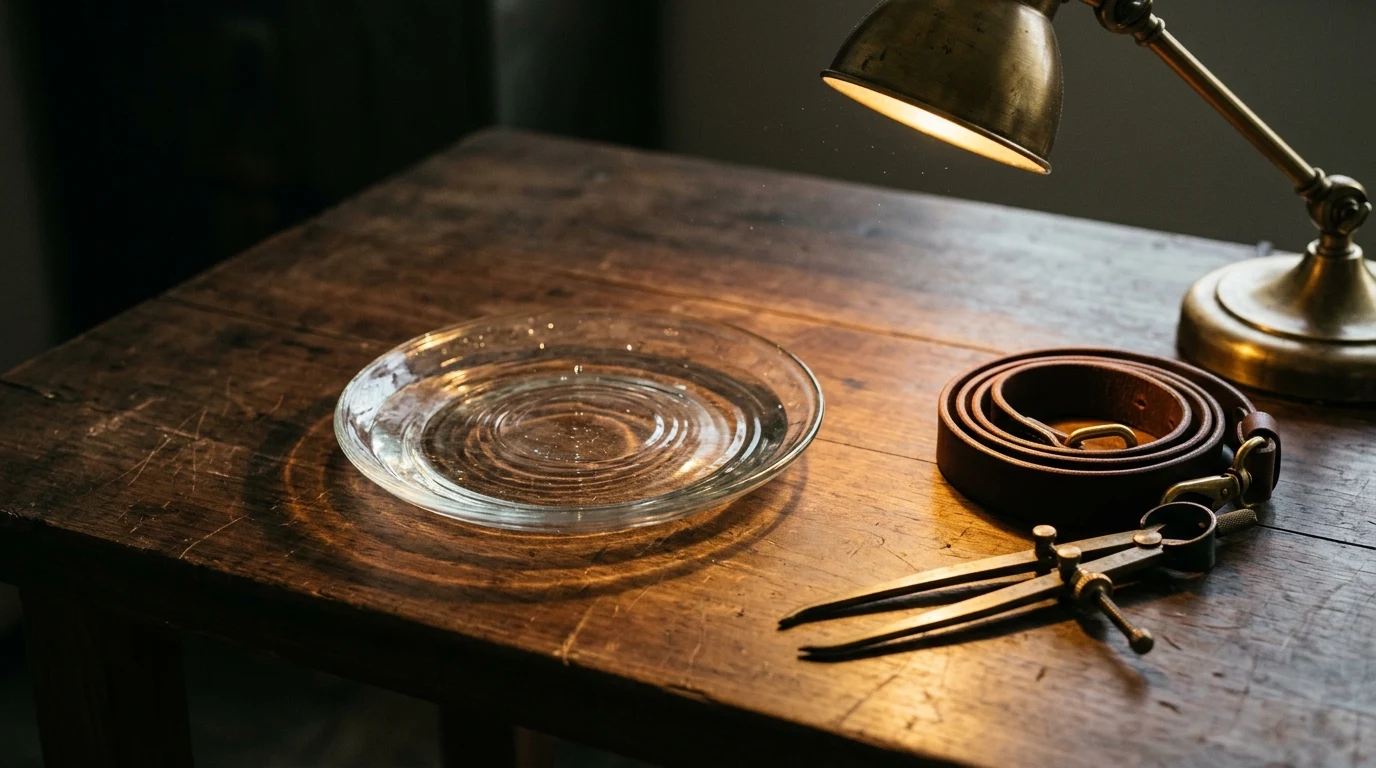
A ripple tank is a shallow glass tray of water lit from one side, and it shows in a few minutes what a textbook needs a chapter to explain. Wikipedia lists reflection, refraction, interference and diffraction among the properties it can demonstrate. The same behavior now runs in a browser as the Ripple Tank simulator, drawn in brass and deep teal to match a leather bench at night.
Water, light and a flat dish
The classic setup is plain: a pan, a shallow layer of water, a lamp and a white card below to catch the shadow of the crests. The Harvard Natural Sciences Lecture Demonstrations page describes circular waves from point sources, plane waves, reflection, refraction and focusing from one tank.

The simulator keeps the same menu. Two dippers make circular waves that cross and interfere. A barrier with a gap shows diffraction. A shallow lens-shaped patch bends the wavefronts. A moving dipper bunches the crests ahead of it.
What the dippers draw
Where two sets of circles meet, crest on crest makes a tall ridge and crest on trough leaves flat water. The result is a fan of still lines running outward from between the sources. Dragging across the water adds bumps by hand.

The frequency slider changes the spacing of the crests. Faster dipping, closer rings. The damping control decides how long a ripple survives, the way a wet hide holds a mark longer than a dry one.
A gap, a lens and a moving source
Narrow the opening in the barrier and the wave spreads out beyond it in rings. The University of Toronto ripple tank notes explain refraction as a change in wave speed across a boundary, which is what the lens scene does: water over the shallow patch moves more slowly, so the crests crowd together and the front bends.

The moving dipper is the odd one out. Crests pile up in front and stretch behind, which is the Doppler shift, visible with no equation.
Why a leather maker keeps one on the bench
Wax on a thread, a stitch pulled tight, a burnish run along an edge: all of it is energy moving through a material. A ripple tank makes that movement visible, and it rewards slow watching. Marcellino NY and x9m8 share an owner, and this app was built for the second site first.

Controls: pick a scene, set the frequency and damping, pause to study a frame, or use Full screen for the whole tank. The app solves a wave equation on a grid in real time, so the patterns are computed, not looped.
Sources
- Wikipedia, Ripple tank
- Harvard Natural Sciences Lecture Demonstrations, Ripple Tank Wave Phenomena
- University of Toronto, Ripple tank experiment notes
- University of Maryland Physics Demonstration Facility, The Ripple Tank


