
A compass needle settles on north and says nothing about why. Michael Faraday wanted the why made visible, and in 1851 he did it with sheets of waxed paper, bar magnets and a sprinkle of iron filings.
Waxed paper and filings
The Royal Institution holds small drawings pasted into a laboratory notebook in 1851, described by the Institution as some of Faraday’s original iron-filings experiments and a picture of his theory of lines of force. In those experiments he coated sheets of paper with a thin layer of melted wax, laid them over bar magnets and poured iron filings on top. The filings gathered around and between the poles.
Faraday called the pattern “lines of force”. NASA’s history page notes that scientists today usually treat field lines as an abstraction for describing magnetic fields, while Faraday felt that space containing them was no longer empty.

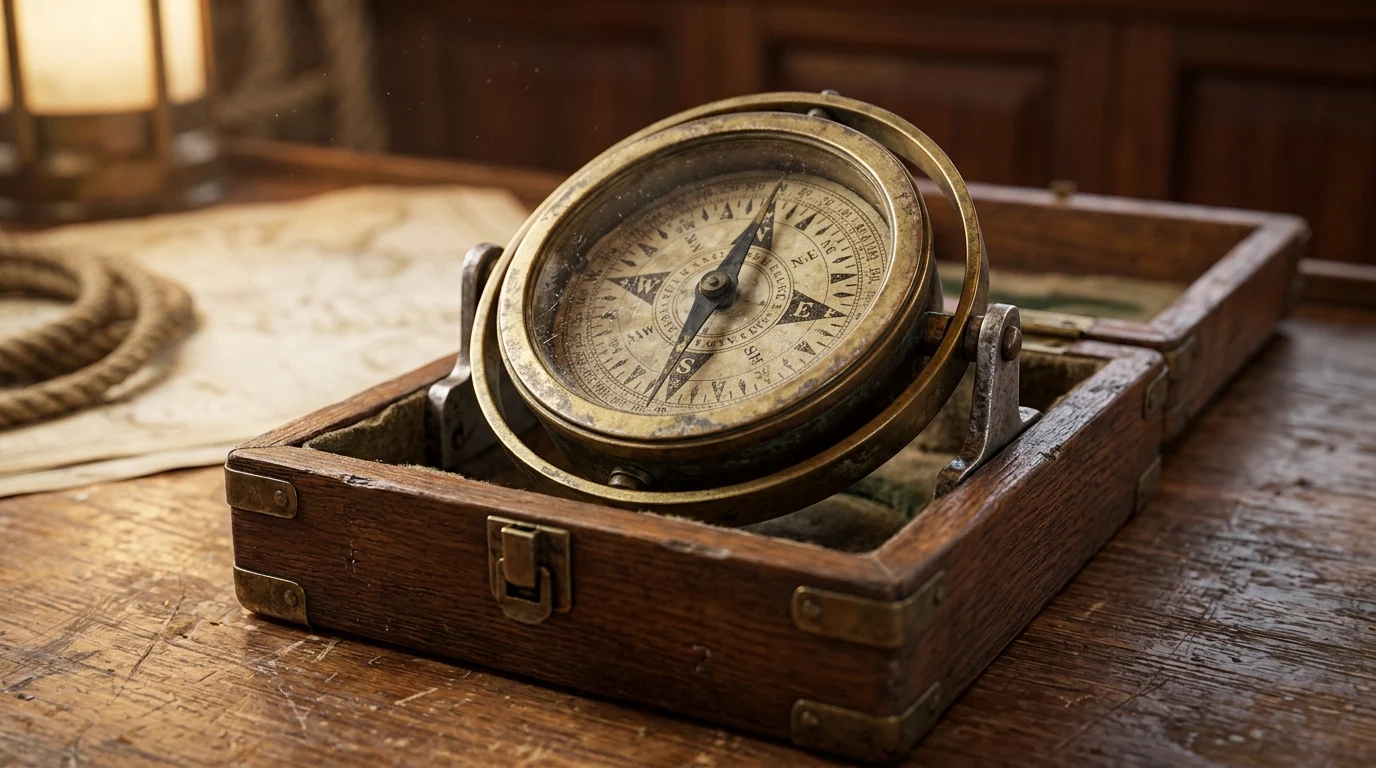
The brass instrument on the desk
The compass is the other half of the story. OpenStax College Physics defines the direction of a field line as the direction the north end of a small compass needle points, and says the strength of the field matches how closely the lines are spaced. A brass-cased compass in a wooden box and a pocket of filings are enough to reproduce the idea at a desk.

Lines that close on themselves
A diagram that stops each line at a pole is only half the picture. JoVE states that field lines emerge from the north pole, loop to the south pole and continue through the magnet back to the north pole, and the University of Texas notes that magnetic field lines never cross and never begin or end in space, running either to infinity or in closed loops.

Moving the magnets yourself
A live bench runs at apps.x9m8.com/magnetic-field, built by the same owner as Marcellino NY. Bar magnets can be dragged, turned and flipped, and the field lines and filings redraw as they move. The app shows only the part of each line that lies outside the magnets, so it is a teaching model rather than a full picture. The physics is written up on x9m8.com.

Sources
- Royal Institution: Faraday’s iron filings, 1851
- NASA: Magnetic Field Lines, History
- OpenStax College Physics: Magnetic Fields and Magnetic Field Lines
- JoVE: Magnetic Field Lines
- University of Texas: Magnetic Field Lines


