
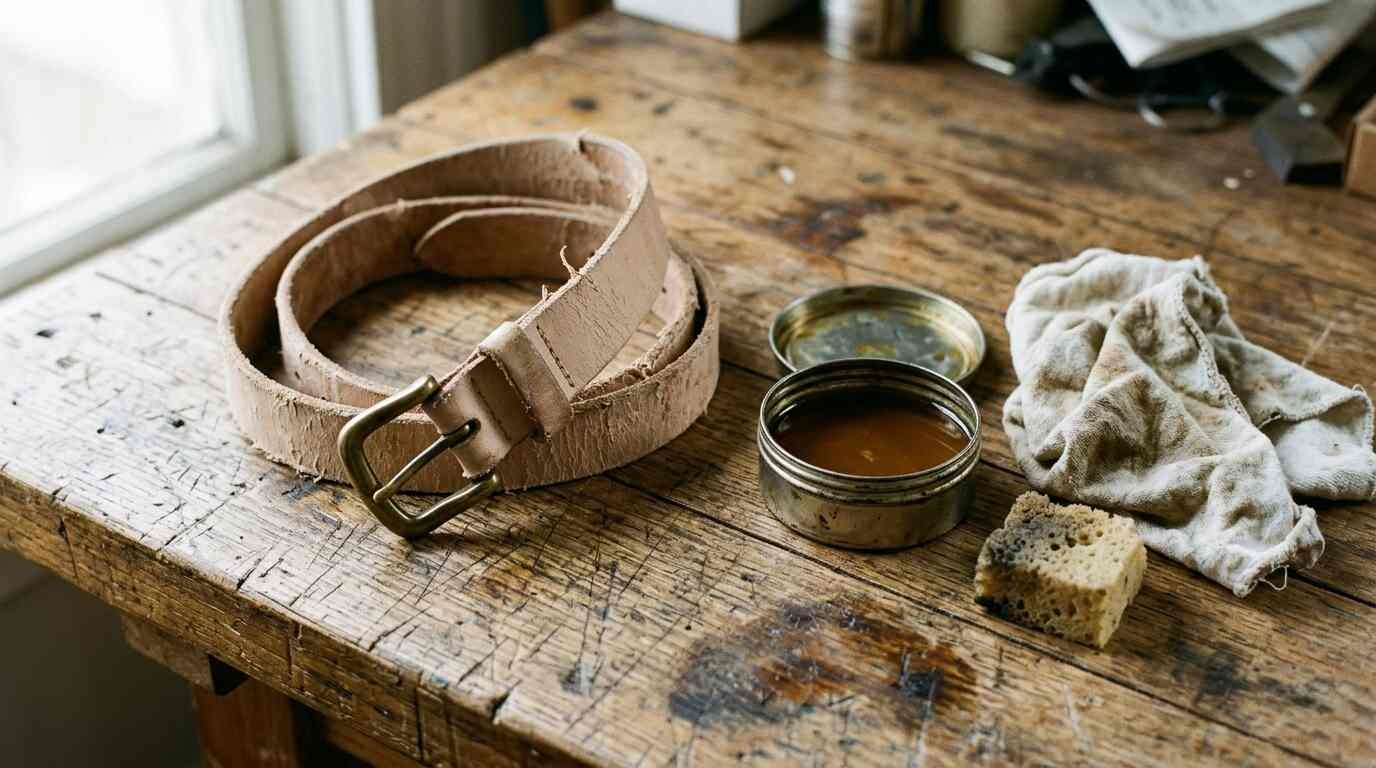
Most of them are starved, not dead. The trick is knowing which one is in your hands.
A stiff, dry strap is vegetable-tanned leather that has lost the oil it left the tannery with, and the fibers inside, with nothing left to slide on, have locked up against each other like a rusted chain. Pick one up out of a closet or a barn and it fights the bend. The grain goes pale. The edges feel like cardboard, and when you flex it at the buckle you can hear it, a dry little creak, the sound of a strap asking for something. My argument is that most of these straps can come back with soap, oil and your hands. I believe that. I also know where it stops being true, and that part comes later, because it matters more.
Video: Adding Oil To Natural Vegetable Tanned Leather, from Marcellino NY Briefcase Maker on YouTube.
That’s from my own channel, oil going onto natural veg-tan. Watch it, then read on, because putting oil into dry leather is the easy half of this job.
Why a strap goes dry
Use takes the oil out, cleaning takes more, and nobody puts it back.

Leather doesn’t dry out from sitting still so much as from living. Sweat, rain, sun, the heat of a car and then the cold of a garage. Every one of those moves oil out of the fibers or moves water in and out of them, and water leaving takes a little oil along with it.
Cleaning is the part people forget. On my leather care page I wrote that cleaners take out dirt and oil both, so conditioner has to follow. The UF/IFAS Extension guide Saddle and Tack Care in Hot and Humid Environments, by McQuagge, Thrift and Johnson, says the same about tack: the oil lost in cleaning has to be replaced to keep leather flexible, and without routine care, saddles and bridles can get too dry and become likely to break.
Storage does the rest. The Canadian Conservation Institute’s note on caring for vegetable-tanned leather recommends keeping relative humidity between 45 and 55 percent, warns that below 30 percent leather loses moisture and gets brittle, and says swings in humidity can harden veg-tan progressively. A strap that spent ten winters on a nail by a furnace and ten summers in a damp shed has been through that cycle every year.
So a dry strap isn’t a mystery. It’s a ledger. Oil out, nothing in.
Clean it before you feed it
Oil on dirt is just oily dirt.
Wipe the strap down first. Old sweat, grime and the remains of whatever the last owner rubbed into it all sit on the grain, and oil poured over that seals it in.
TomE, answering a question on Leatherworker.net about restoring dry harness leather, describes a plain method: saddle soap on a sponge with warm water, work up suds, wipe with clean water, rinse the sponge often. He adds that there’s no need to soak the leather. UF/IFAS prefers liquid saddle soap because it goes on and rinses off more easily than bar or cake.
One warning, from the conservators. CCI calls saddle soap very alkaline and says it degrades leather and can leave a white scummy residue. That’s written for museum pieces, and a working strap isn’t one. But it tells you something: soap is a tool, not a treatment. Use a little, rinse it, and don’t scrub a dry strap every week because it makes you feel productive.
Then let it dry. Hang it, flat or loose. The Cheshire Horse, a tack shop with its own care blog, says in its post on restoring and repairing tack to let it dry on its own and “never use heat to dry it as this will dry out the leather more.” That’s the whole rule. No radiator, no hairdryer, no dashboard in July.
Not bone dry, though. Both UF/IFAS, for antique leather, and TomE say the oil can go on before the leather is completely dry, while it’s still a little damp and open.
Warm oil, thin coats, and patience
The strap drinks slowly. Pour faster than it drinks and you drown it.

Here’s the part that feels good. Oil goes on, the pale grain goes dark, and the strap starts to move in your hands again. Every instinct says more.
Don’t. Cheshire Horse warms its oil to about 100°F and lays on several thin coats over hours or days, wiping off the excess with a lint-free cloth before sealing with a balm. Weaver Leather Supply’s conditioner guide says the same in fewer words: thin, even layers, let each one soak in before the next. It also lists dryness, stiffness and a dull look as the signs that leather is due.
Which oil is an older argument, and the piece on tack room conditioning myths goes through it properly. The short version from the fetched sources: UF/IFAS says pure neatsfoot mildews more readily than other oils in hot, humid climates and says to stay away from corn and vegetable oils. TomE prefers pure neatsfoot to the compound, which he says contains petroleum products. In the same thread, Mulesaw describes a tallow and neatsfoot paste, from a recipe in Saddle Makers Illustrated Journal, that was meant for work harness.
I condition with beef tallow and leather oil. On a strap that’s been starved for years, my opinion is oil first, because it moves deeper and faster, then tallow over the top once the strap has stopped drinking, to close it up. The post on beef tallow covers what tallow does once it’s in there.
Work it in with your hands
Oil softens the fibers. Your hands are what get them moving.
Leave a freshly oiled strap on the bench and it softens a little. Work it and it comes back.
Roll it slowly over your fist, grain out, a few inches at a time, the full length. Then grain in. Flex it at every hole and around every fold where it’ll bend in use, the buckle fold most of all. Your palms warm the oil and push it along. You’ll feel the fibers let go one stretch at a time, stiff in one spot, easy in the next, and somewhere along the way the creak goes quiet.
This is the same thing a new strap needs to break in, and the piece on breaking in a stiff briefcase is about the bigger version of the same work. Hands do it better than oil does.
My straps start life as two pieces. I split strap leather on an old hand-crank splitter, thin it, and stitch two pieces together so the strap has a good face on both sides. A strap built like that has a stitch line down both edges and a glue line through the middle, and when one of those goes dry, flexing it is also how you find out whether the seam is still holding. A loose stitch shows itself on the bend.
Where oil stops helping
Here’s the hole in my argument: oil gives a strap its feel back, not its strength.

I’ve made the case that most dry straps come back. Now the harder part. A strap that has dried, flexed and cracked has broken fibers, and broken fibers don’t knit. Oil lubricates what’s left. It makes a cracked strap bend quietly instead of creaking, which is worse, because now it looks alive.
UF/IFAS puts it in eight words: “Cracked leather in stress areas should be replaced.” It also says every leather product has a usable life. Cheshire Horse says don’t ride, work or handle a horse in tack that is very dry, cracking or broken, and that if you’re in doubt, assume the piece needs replacing or repair. Those guides are about tack holding a horse. A briefcase strap holding a laptop over a subway platform is a smaller load, but the failure is the same: it lets go at the buckle, all at once.
Too much oil does its own damage. UF/IFAS says excess oil can break leather down, invite mildew and darken it. TomE says plainly that you can ruin leather for good by over-oiling it, leaving it sticky and spongy. Weaver says over-conditioning leaves leather too soft, losing firmness. A strap that’s gone soft and stretchy has traded one way of failing for another.
And some leather is past all of it. The Museum of Fine Arts Boston’s CAMEO database describes red rot as irreversible: a powdery red surface, cracking and a loss of strength, most often in veg-tan made from the late 1800s into the early 1900s. If your thumb comes away rusty, oil won’t save that strap.
The museums go further. The National Park Service’s Conserve O Gram on leather dressings says research found dressings had no preservative effect, and tells caretakers to refrain from dressing museum leather. CCI says applied oils can stiffen leather over time as they oxidize. Both are writing about objects that sit in a case. NPS itself allows that personal items which have to keep working may be another matter. A strap is that. But the warning still lands on me: the feeling that I’ve saved something by oiling it is not proof that I have.
Test it before you trust it
Bend it hard where it bends in use. Read the grain. Then decide.
After the oil and the hand work, give it a few days, then fold the strap grain-out, tight, at the buckle and at each hole. Look close. Fine crazing that closes back up when you straighten it is surface. A crack that opens into the body of the leather, or a hole that has stretched into a teardrop, is the strap telling you it’s done. Pull it against your knee. Listen. Watch the stitching at the buckle.
If it fails, you haven’t lost much. The buckle comes off and goes on a new strap. On my own straps the buckles are stitched in, no rivets, so a dead strap gives up its hardware with an awl and a few minutes of cutting thread. The piece on caring for a leather belt has more on what kills straps of that shape before their time.
Should it pass, keep it fed and keep it out of the cycle that dried it. Store it away from a furnace or a hot attic, the way the guide to storing a briefcase between seasons lays out for the bag it hangs from. Feed it before it goes pale again, not after.
And sometimes it passes and you replace it anyway, because it’s on a bag someone carries every day and you’d rather lose a strap on the bench than on the street. I’d make that call myself. A strap is cheap. The case it’s holding isn’t.
Pure Neatsfoot Oil, 8 oz: An 8 oz bottle of pure neatsfoot oil for leather. See it on Amazon (affiliate link).
Leather Conditioner with Grass-Fed Beef Tallow and Lanolin: A leather conditioner made with grass-fed beef tallow and lanolin. See it on Amazon (affiliate link).
Skidmore’s Leather Cream: A leather conditioner cream, one option for the conditioner step. See it on Amazon (affiliate link).
John James Saddlers Harness Blunt Point Needles: A set of blunt-point harness needles, five sizes with five needles of each. See it on Amazon (affiliate link).
Mandala Crafts 150D 0.8mm Black Flat Waxed Thread: A flat waxed polyester thread, 0.8 mm, in black, for hand sewing leather. See it on Amazon (affiliate link).
General Tools Scratch Awl with Hardwood Handle: A scratch awl with a hardwood handle. See it on Amazon (affiliate link).
As an Amazon Associate I earn from qualifying purchases. A commission may be earned if you buy through this link, at no extra cost to you.
Sources
- UF/IFAS Extension, Saddle and Tack Care in Hot and Humid Environments (AN303), McQuagge, Thrift and Johnson: https://ask.ifas.ufl.edu/publication/AN303/pdf
- The Cheshire Horse, Restoring and Repairing Tack: https://blog.cheshirehorse.com/2021/01/29/restoring-and-repairing-tack/
- Canadian Conservation Institute, Care of Alum, Vegetable, and Mineral Tanned Leather: https://www.canada.ca/en/conservation-institute/services/conservation-preservation-publications/canadian-conservation-institute-notes/care-alum-vegetable-mineral-leather.html
- National Park Service, Conserve O Gram 9/1, Leather Dressings: https://www.nps.gov/articles/conserve-o-gram-9-1-leather-dressings.htm
- MFA Boston CAMEO, Red rot: https://cameo.mfa.org/wiki/Red_rot
- Weaver Leather Supply, Best Leather Conditioners for Different Types of Leather: https://www.weaverleathersupply.com/pages/best-leather-conditioners-for-different-types-of-leather
- Leatherworker.net, Restoring dry harness leather: https://leatherworker.net/forum/topic/111172-restoring-dry-harness-leather
- Marcellino NY, Leather Care: https://marcellinony.com/leather-care/
You Might Also Like
- How to Break In a Stiff Leather Briefcase Without Hurting It
- How to Store a Leather Briefcase Between Seasons
- Original or Restored: A $495,000 Auction Gap and the Argument Over Patina


