
A team of scientists in Lanzhou built a fake tongue. To mimic one, they made a plastic hydrogel containing mucin, the slippery protein of saliva, and measured the friction between a soft plastic ball and a glass surface coated with mucin. Then they added tannic acid, and in the words of the Asian Scientist report on the work, the friction rose substantially.
That grab is what a dry red does on Thursday afternoon, somewhere between the stuffing and the second helping. Phys.org’s summary of the same study described the sensation as “dry, leathery, or even furry.” The word leathery is doing more work there than the writer may have meant. The molecules responsible belong to the same family a tanner uses to turn a raw hide into something that can hold a buckle.
The Same Word on Two Labels
Polyphenols that grab protein
Decanter’s explainer on wine tannins, by Ines Salpico, puts the link plainly. Tannins are bitter, astringent compounds in the larger group called polyphenols, and they have a unique ability to easily combine with other molecules, especially proteins. That ability, Salpico writes, “is the basis of leather production, in which the structure of animal hide is changed (tanned)”.

In a glass of red, the tannin comes mostly from grape skins and seeds, with a smaller share from stems. Oak barrels, if the wine spent time in them, add more.
Tanneries draw on other sources. Britannica’s entry on tannin says the compounds occur particularly in the bark of oak species, and in galls, the swellings trees grow after insect attacks, and that tannins are used chiefly in tanning leather, dyeing fabric and making ink. The same entry notes that tannin solutions are acidic and have an astringent taste, which is the tasting note and the trade description in one sentence.
Oak shows up on both sides. A barrel and a bark pit are not the same thing, though both put oak tannin into contact with something that will change because of it.
What Happens on the Tongue
A lubrication failure, measured on glass
The Lanzhou work, by a team working with Feng Zhou at the Chinese Academy of Sciences and collaborators at KAIST in Daejeon, appeared in Angewandte Chemie International Edition in 2016 under the title “Astringent Mouthfeel as a Consequence of Lubrication Failure” (DOI: 10.1002/anie.201601667).
- The target. Tannins bind to mucins, the lubricating proteins in the mucus membranes of the mouth.
- The effect on the protein. When tannic acid binds to mucin, the interaction reduces the protein’s solubility in water, according to Phys.org.
- The measurement. The researchers used a quartz crystal microbalance to monitor how the proteins adsorbed and precipitated, alongside the friction tests on mucin-coated glass. Phys.org’s summary says the mouth’s lubricating film fails once tannins arrive, and the tongue feels less slippery.
The model is a hydrogel and a glass slide, not a mouth. What it shows is mechanical: tannin plus slippery protein produces less slip.
What Happens in the Pit
Hydrogen bridges, collagen, and fifteen to forty percent by weight
The protein a tanner works on is collagen. Britannica’s entry says it sits in the dermis, the connective layer of skin, and that it is especially rich in the amino acid glycine and the only protein known to contain a substantial share of hydroxyproline. Boiling water turns it into gelatin.

The trade press describes the tanning bond in specific terms. A 2005 Leather International profile of vegetable tannins says that acidic groups of vegetable tannins may combine with the basic groups of the hide collagen, and describes the result as cross-linking through hydrogen bridges. A 2003 Leather International analysis of combination tanning adds hydrophobic bonds to the picture, attributing the effect of vegetable tanning on its own to multiple hydrogen-bond and hydrophobic-bond cross-links.
The quantities are not a sip. A 2018 review in the journal Molecules by Lina Falcão and Maria Eduarda M. Araújo, on the vegetable tannins used in historic leathers, defines tannins by their property to precipitate proteins and reports that collagen stabilization occurs when 15 to 40 percent of tannins, per dry weight of skin, are absorbed.
Tanners sort their material more finely than a wine label does. The 2005 Leather International profile divides vegetable tannins into two chemical camps, pyrogallol, or hydrolysable, and catechol, or condensable, and groups both with synthetic tannins as aromatic tanning agents, apart from mineral agents such as chrome and aliphatic agents such as aldehydes. Britannica adds a detail from the pit side of the trade: condensed tannins, the larger group, form insoluble precipitates called tanner’s reds, or phlobaphenes.
Getting that much tannin into a thick hide took the eighteenth century a long time. Colonial Williamsburg’s booklet on the colonial leatherworker, by Thomas K. Ford with Harold B. Gill Jr., says careful tanning required from several weeks for a light skin to eighteen months for a heavy hide.
Where the Two Reactions Line Up
Weak bonds doing heavy work
The overlap is narrower than the headline suggests, but it is real.
- Same class of molecule. Decanter and Britannica both identify tannins as the agent in leather and the source of astringency.
- Same habit. Both reactions are tannin binding protein. Falcão and Araújo define tannins by their power to precipitate proteins; the Lanzhou group watched tannic acid make mucin less soluble.
- Similar bonds. A paper on the colloidal stability of tannins by D. Zanchi and colleagues, posted to arXiv in October 2008, describes tannins binding to the proline sites of proteins by H-bond and hydrophobic interactions. The leather literature cited above names the same two bond types for tannin on collagen.
Zanchi’s group also points at evolution. The paper notes that herbivores developed proline-rich proteins in saliva, and treats tannins’ affinity for those salivary proteins as fundamental to astringency. On that account, a grazing animal carries in its own saliva a defense against the same chemistry the tanyard runs on.
Where the Comparison Breaks
A sip is not a tanning
No source here calls the two reactions identical, and there are good reasons not to.

Start with the proteins. In the mouth, the targets are mucins and salivary proteins. In the hide, the target is collagen, with its unusual load of glycine and hydroxyproline. Different proteins give tannins different footholds.
Scale is the bigger gap. A mouthful of wine is a brief contact between a dilute solution and a thin film, while a hide in a pit sits for weeks or months and has to absorb 15 to 40 percent of its own dry weight in tannin before its collagen is stabilized, on the Falcão and Araújo figures.
How firmly the tannin holds is a third difference, and the leather side is less impressive than it sounds. The 2003 Leather International analysis calls the stabilizing effect of solo vegetable tanning minimal, and reports that up to 95% of the bound tannins can be washed out of vegetable-tanned leather by 50 percent acetone, leaving about 5 percent irreversibly combined with the collagen, and that stripping the tannin drops the leather’s shrinkage temperature almost to that of untanned collagen. On that evidence most of the tannin in vegetable-tanned leather is held by weak bonds, a great many of them, with only a small share fixed for good. Saliva is not acetone, and a sip is not an eighteen-month pit.
The science of astringency has its own disagreement. The Lanzhou work frames the dry feeling as a friction problem: the lubricating film breaks down. Zanchi’s group puts the weight on tannins binding salivary proline-rich proteins and the colloidal behavior of the resulting clusters. The two accounts can coexist, since a protein pulled out of solution is also a protein no longer lubricating, but they emphasize different steps, and neither claims the mouth is being tanned.
The Bottle and the Belt
Two jobs, one family of molecules
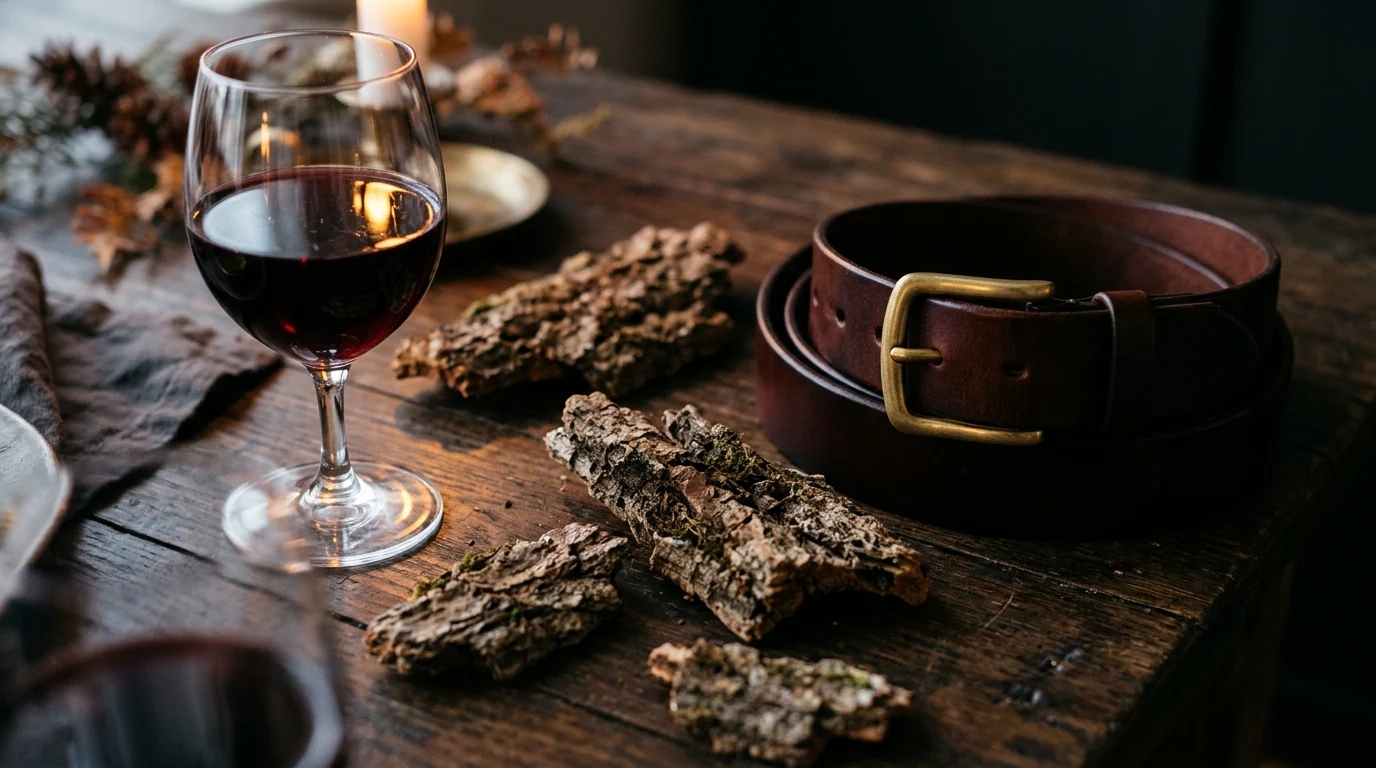
A bridle belt at the Thanksgiving table and a glass of red beside the plate are, chemically, distant cousins who share a surname. The wine’s tannin meets the tongue for seconds. The hide’s tannin spent months in bark liquor, the pit method Falcão and Araújo connect with heavy and strong leathers for shoe soles, belting or harness.
Bridle leather belongs to the bark side of this comparison: Weaver Leather Supply sells Hermann Oak’s bridle sides as 100% veg tanned. Marcellino NY makes and sells English bridle leather goods, so the house has an interest in the slow side of this comparison. The chemistry holds without that interest. The same habit, polyphenol meeting protein, gives one a dry tongue and the other a strap stiff enough to carry a buckle and soft enough to bend around a waist.
Zhou’s team needed a quartz crystal microbalance to see the effect on a fake tongue. A tanner in Williamsburg needed up to eighteen months and a row of vats to see it in a heavy hide.
You Might Also Like
- Inside the Chouara Tannery in Fez: How Leather Is Made
- Indoor Heat and Leather: Where to Keep a Briefcase
- Reviving a Stiff, Dry Strap
Sources
- “Why Do Our Mouths Feel Dry After Drinking Wine?” Asian Scientist, April 22, 2016: https://www.asianscientist.com/2016/04/in-the-lab/mouth-dry-wine-tannins-mucins-friction/
- “Astringent mouthfeel of wine results from a lubrication failure in the mouth,” Phys.org (2016): https://phys.org/news/2016-04-astringent-mouthfeel-wine-results-lubrication.html
- Ma et al., “Astringent Mouthfeel as a Consequence of Lubrication Failure,” Angewandte Chemie International Edition, 2016, DOI: https://doi.org/10.1002/anie.201601667 (citation as given by Phys.org and Asian Scientist; the publisher page could not be loaded)
- Ines Salpico, “Tannins – What are they and what do they do?” Decanter, August 27, 2024: https://www.decanter.com/learn/tannins-45814/
- “Tannin,” Encyclopaedia Britannica: https://www.britannica.com/science/tannin
- “Collagen,” Encyclopaedia Britannica: https://www.britannica.com/science/collagen
- “The profile of vegetable tannins: properties and performance,” Leather International, October 24, 2005: https://www.leathermag.com/?p=4525
- “New insight into combination tanning,” Leather International, September 15, 2003: https://www.leathermag.com/analysis/new-insight-into-combination-tanning/
- Lina Falcão and Maria Eduarda M. Araújo, “Vegetable Tannins Used in the Manufacture of Historic Leathers,” Molecules 23(5), 1081, 2018: https://mdpi.com/1420-3049/23/5/1081
- D. Zanchi, C. Poulain, P. Konarev, C. Tribet, D.I. Svergun, “Colloidal stability of tannins: astringency, wine tasting and beyond,” arXiv: https://arxiv.org/pdf/0810.1136
- Thomas K. Ford, with Harold B. Gill Jr., The Leatherworker in Eighteenth-Century Williamsburg (Colonial Williamsburg), Project Gutenberg text: https://dev.gutenberg.org/files/58293/58293-0.txt
- Weaver Leather Supply, “Hermann Oak® Bridle Leather, Sides” product page: https://www.weaverleathersupply.com/products/hermann-oak-bridle-leather-sides


