
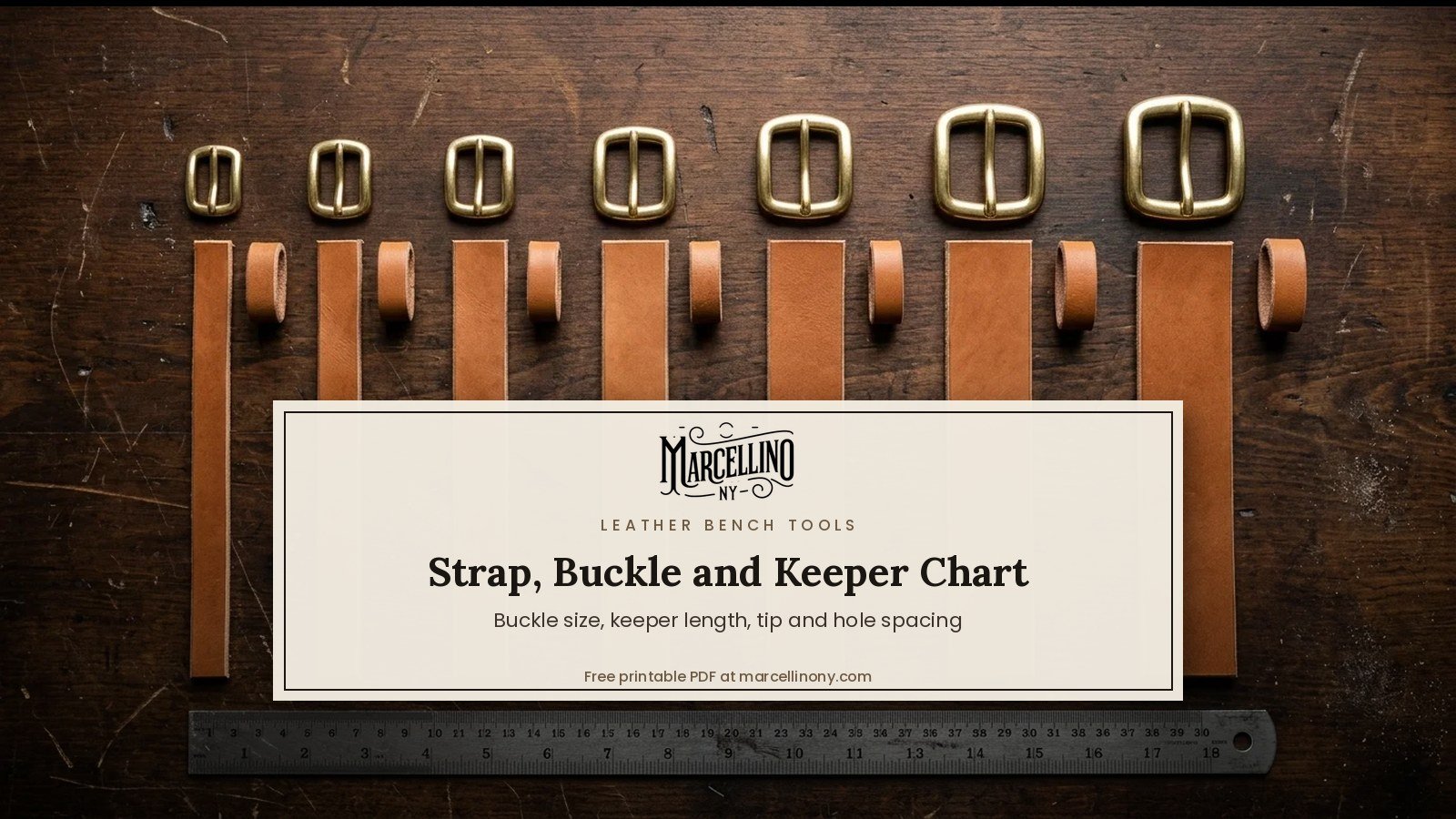
A buckle sold as 1½ inch is not 1½ inches across. Weaver Leather Supply’s page for its #899 buckle lists a strapping size of 1½ inches and a total width of 55 millimeters, about 2.2 inches. The number on the bag is the strap the buckle takes.
Marcellino NY Bench Tool No. 12
Strap, Buckle and Keeper Chart: Free Printable PDF
⬇ DOWNLOAD THE BENCH TOOL (PDF)2 pages · US Letter, print at 100% · buckle size, keeper strip length, tip length and hole spacing for 1/2 to 2 inch straps, worksheet
The free Marcellino NY Bench Tool No. 12: Strap, Buckle and Keeper Chart starts there and works through the rest of a strap: the keeper that holds the tail down, the tip, and the holes.
A buckle is sized by its strap
On Weaver’s #481 buckle page it reads “Size denotes strap width.” Sailrite puts it in terms of the frame for its own brass buckle: the size refers to the inside buckle dimensions.
Both mean the same thing for the maker. Cut the strap to the buckle’s number, and the strap slides through the frame with the small clearance the maker of the buckle already built in. Measure the outside of the frame and cut to that, and the strap rattles.
The other direction matters too. A buckle bought for a strap that already exists should be measured across the inside of the frame, where the strap passes, not along the bar the tongue hangs from.
The keeper is a loop around two layers
A keeper is the small band that holds the free end of the strap flat after it passes through the buckle. It wraps two things at once: the strap, and the tip that has come round and lies on top of it.
So the loop has to go around a stack two straps thick. Its length, measured along the middle of its own leather, is two strap widths plus two stack heights, with the keeper’s own thickness added at each turn. For a strap 3.5 millimeters thick and a keeper 2 millimeters thick, butt-joined with no overlap, that comes out like this:
| Strap width | Keeper strip, butt joint | Three times the width |
|---|---|---|
| ½ in | 1.87 in (47 mm) | 1.50 in |
| ¾ in | 2.37 in (60 mm) | 2.25 in |
| 1 in | 2.87 in (73 mm) | 3.00 in |
| 1¼ in | 3.37 in (86 mm) | 3.75 in |
| 1½ in | 3.87 in (98 mm) | 4.50 in |
| 2 in | 4.87 in (124 mm) | 6.00 in |
The third column is a common rule. Dictum’s guide to making a leather belt says the piece for the keeper loop should be approximately three times the width of the strap, then gives the real method: stack a layer of the fold and a layer of the strap and wrap the leather around them to find the exact length.
Three times the width is close to right at an inch, short for narrow straps and generous for wide ones, which makes it a sensible piece to cut from and a poor length to sew.
iFixit’s keeper replacement guide is a useful check from outside leatherwork. For a 1½ inch belt, it cut a strip 4 by ½ inch and wrapped it with 1 centimeter of overlap. Take the overlap away and the loop is about 3.6 inches, about a quarter inch short of the table’s 3.87. iFixit does not give its belt’s thickness.

Thick keepers fight back
A keeper cut from the same leather as a heavy strap is hard to sew and stands proud of the belt. On a leatherworker.net thread about belt holes, a member who made a keeper from a 4 millimeter bridle offcut found it very hard to sew into the belt end. One reply said that, depending on width, 2 to 2.5 millimeters is lots for a keeper. Another maker said to use the same weight leather as the belt itself, and to cut the strip no longer than it takes for two layers to fill the space, sized around a fixture made of the real leather.
The two disagree on thickness. The PDF’s keeper column uses 2 millimeters because thinner keepers are easier to sew and sit flatter. For a thicker keeper, the worksheet on page 2 adds the extra.

Tip and holes
The tip and holes are where makers stop agreeing. On a thread about belt end length, one maker gives what he calls the traditional rule: the end runs 2½ times the belt’s width from the last hole to the point, with five holes spaced the width of the belt apart and the middle hole at the wearer’s size. The next reply says there is no standard formula, at least not on the west side of the Atlantic.
The traditional rule gives a 1½ inch belt holes 1½ inches apart and a 3¾ inch tip. A dress belt usually wants tighter adjustment than that, and a leatherworker.net thread on belt rules of thumb makes the general point that the narrower the strap, the closer the holes need to be. The same thread suggests three times the strap width from the billet end to the first hole, which leaves enough tail to pass through the keeper.
Briefcase shoulder straps sit in between. The Marcellino NY video at the top of this page shows them punched one inch apart on a thick chestnut strap.
Watch straps are their own scale. Delugs’ strap length guide lists 6 millimeters between holes and holes 1.8 millimeters across.
Where the chart fits
The belt pattern in the Marcellino NY series gives cut length for a belt by size. This chart covers the parts that pattern borrows from and that every other strap needs too: the dog collar, the bag strap, the luggage tag, the briefcase front strap. The dog collar pattern already uses five holes an inch apart; with this chart, the keeper for it can be cut once instead of three times.
Page 1 of the PDF holds the table for straps from ½ to 2 inches: buckle size, keeper strip at two strap thicknesses, the traditional tip, holes at the traditional spacing and at one inch, and first hole from the billet end. Page 2 is a worksheet for any strap that does not fit the table, a stack of real leather to measure, and room to record the wrap test for each strap.

Marcellino NY Bench Tool No. 12
Strap, Buckle and Keeper Chart: Free Printable PDF
⬇ DOWNLOAD THE BENCH TOOL (PDF)2 pages · US Letter, print at 100% · buckle size, keeper strip length, tip length and hole spacing for 1/2 to 2 inch straps, worksheet
Sources
- Weaver Leather Supply, #899 buckle (strapping size and total width): https://www.weaverleathersupply.com/products/899-1-1-2-n
- Weaver Leather Supply, #481 buckle: https://www.weaverleathersupply.com/products/481-buckle
- Sailrite, belt buckle 1-1/2 in brass: https://www.sailrite.com/Sailrite-Belt-Buckle-1-1-2-Brass
- Dictum, making personalised leather belts: https://dictum.com/en/blog/tutorials/making-personalised-leather-belts
- iFixit, belt loop keeper replacement: https://www.ifixit.com/Guide/Belt+Loop+Keeper+Replacement/179567
- Belt holes thread, leatherworker.net: https://leatherworker.net/forum/topic/72498-belt-holes
- Belt end length thread, leatherworker.net: https://leatherworker.net/forum/topic/52573-belt-end-length
- What are the belt rules of thumb, leatherworker.net: https://leatherworker.net/forum/topic/27072-what-are-the-belt-rules-of-thumb
- Delugs, strap length guide: https://delugs.com/pages/strap-length-guide
- Video: Punching Buckle Holes on Briefcase Shoulder Strap, Marcellino NY Briefcase Maker: https://www.youtube.com/watch?v=g_GH5gsB3f0
You might also like
- Hand-Stitched Leather Belt Pattern and Sizing Chart
- Leather Dog Collar Pattern: Cut Length and Hole Spacing
- Replacing a Worn Buckle or Keeper
- Rivet, Snap and Chicago Screw Sizes for Leather: A Post Length Chart


