
A steel rule lies beside two round brass plates, and one of them has a notched square cut out of its middle. Before an English lock goes on a briefcase, the parts get measured, and the photographs from the bench show that step.
Marcellino NY Briefcase Maker on YouTube: The Last English Made Classic Solid Brass Briefcase Key Lock Made.

What is on the bench
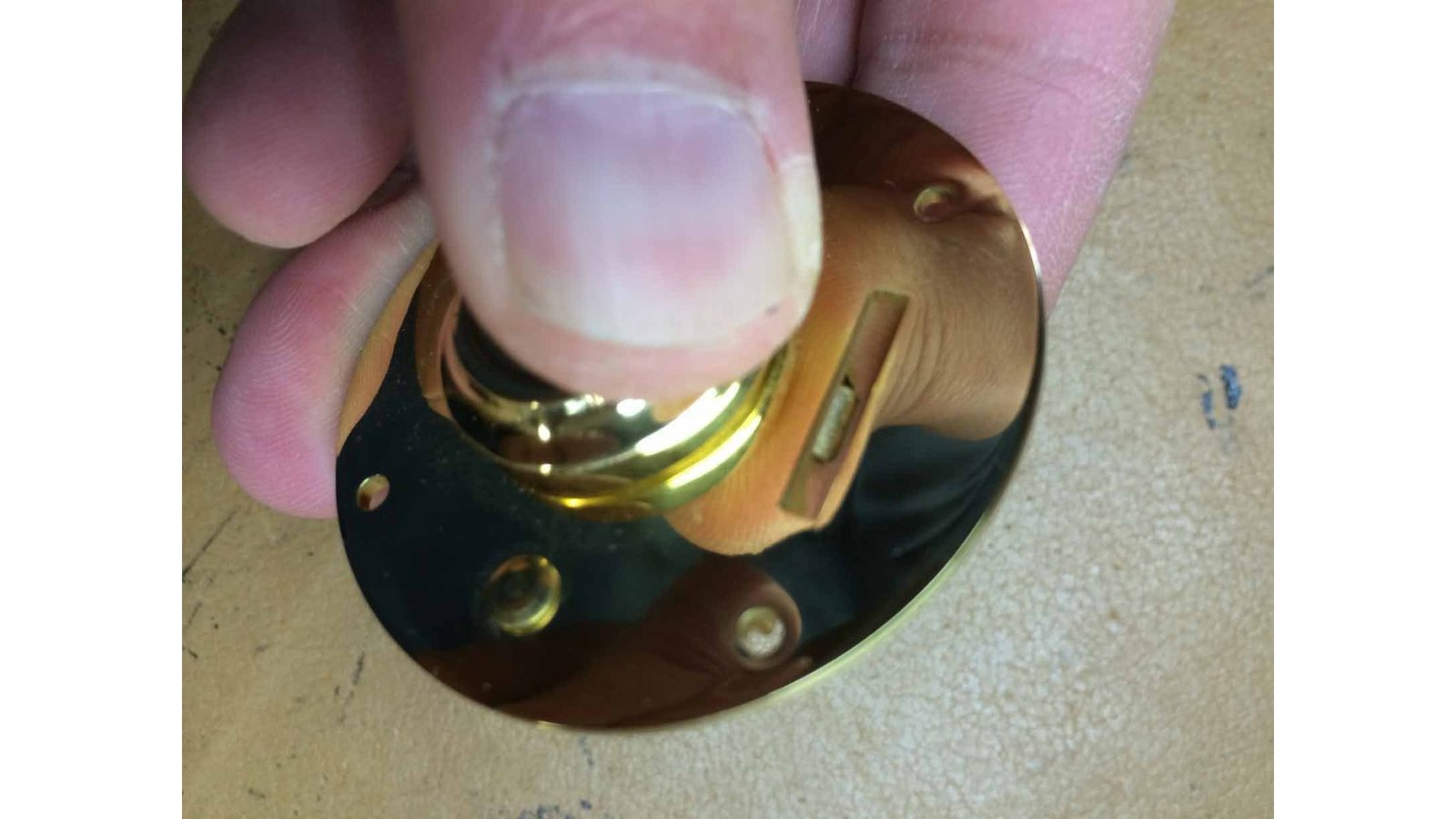
The first photograph shows two round brass plates. One has a keyhole stem at the center and the other has an opening cut with stepped edges. A third shot puts the rule against the stepped plate to read the width of the cut. Another shows the lock body, a brass box with a tab, sitting on its round plate with screw holes around the edge.
It is solid brass, and brass takes a polish. In the close shot the plate is bright enough to reflect a thumb.
Why a lock gets measured
The lock has to fit a cutout in the flap and a cutout in the body panel, and both need to line up with the plate behind. If the cut is too big, the lock rocks. If it is too small, the leather is forced and the grain splits around the opening.
The leather is expensive and the lock is expensive. So the measuring happens on the bench with the rule, before the knife touches the flap.


Riveted, not screwed
This is the classic English brass tube key lock. In my videos I explain that it goes on with rivets rather than screws, and that I compare it with Italian locks that use screw posts, locks I designed. A rivet that is hammered flat is not coming out. A screw can back out over years of opening and closing.
I also say in the video that the lock is made by the last English maker, and that is my own statement, not something I can cite. What the photographs show is the lock itself, solid brass.
Where the old ones come from
I own old briefcases fitted with the same lock style, which I describe in my videos as 75 to 100 years old. The design has been around that long.
These locks are not forever. They rust if neglected and the internals can break. A brass lock lasts longer than a painted pot-metal one, but it is still a mechanism with moving parts, which is why I describe it in the videos as great but not as permanent as a buckle.
Sources
- Marcellino NY Briefcase Maker, The Last English Made Classic Solid Brass Briefcase Key Lock Made: https://www.youtube.com/watch?v=tW7ZjCvduc4
- Marcellino NY Briefcase Maker, Classic English Brass Round Rivet Briefcase Tube Key Lock: https://www.youtube.com/watch?v=Sn-fNled6jI


