
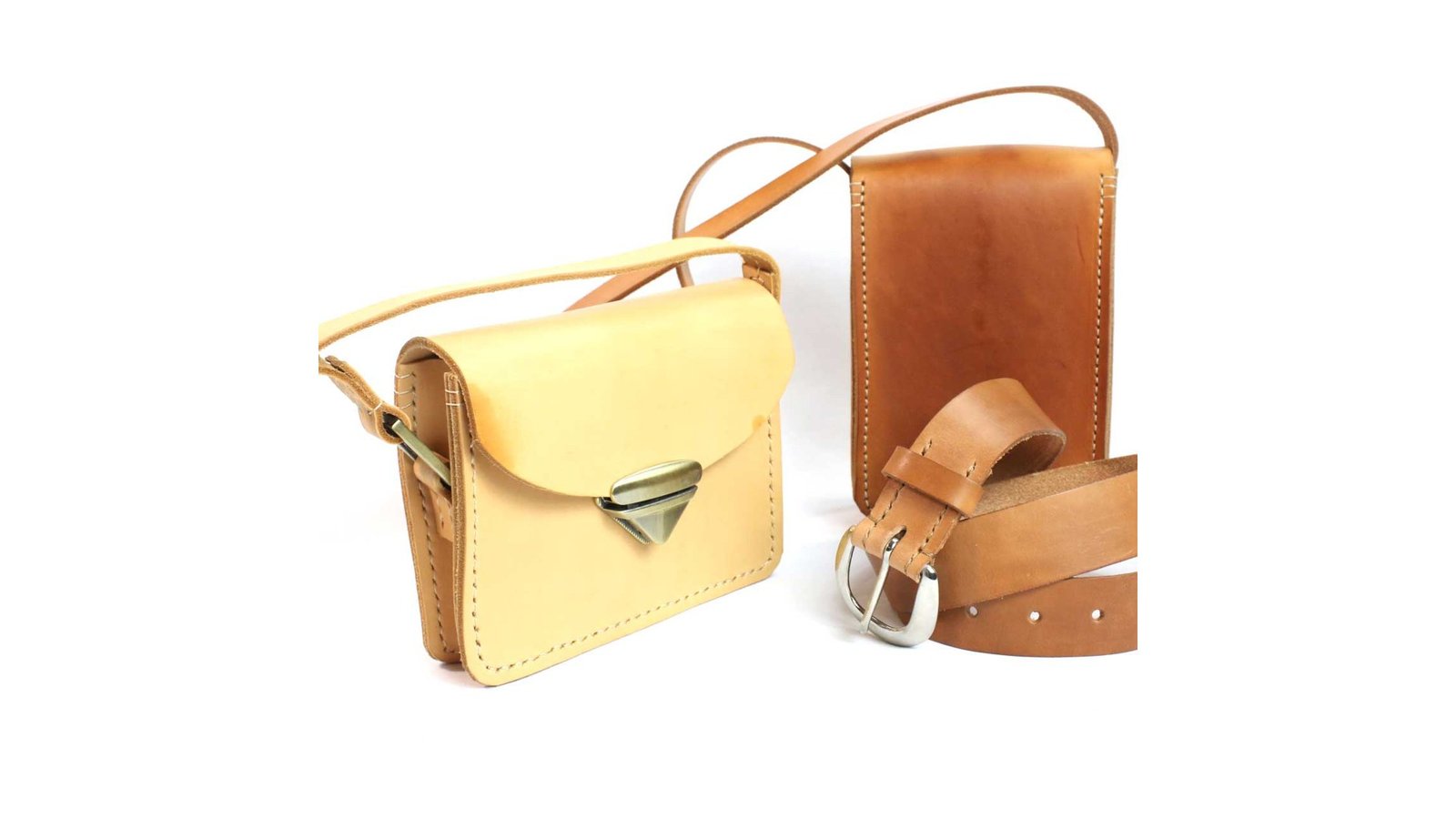
Three pieces share a white backdrop. On the left, a small flap bag in a pale straw color with a bronze turn-lock shaped like a triangle. At the back, a taller pouch in a deep honey-brown with the same cream stitching. In front, a belt coiled loosely, its buckle in polished nickel, a shade between the two. All three began as the same kind of leather.
Marcellino NY Briefcase Maker on YouTube: darkening natural vegetable-tanned leather with oil.

The photograph does not say how long separated the pieces, or what each has been through. It does show what the range looks like, which is the question people ask first about natural leather: what will it do?
What drives the change
The answer comes in four parts, and they combine.
Light. A care page for a vegetable-tanned goods maker says undyed leather will tan or darken in sunlight. A leather maker’s information page describes the cause as the leather responding to UV light, not damaged, but speeding up the natural color shift.
Oil. Conditioning darkens leather, and repeating it moves the process along. The same Walnut Studiolo page says doing it several times in a row can speed the darkening and help match a color.
Water and fat. A technical dictionary notes that, in uncolored vegetable-tanned leather, the leather darkens by light, moisture and fat, with grease first darkening the surface and then drying paler as it dries out.
Handling. The oils in skin matter. One retailer says vegetable-tanned leather responds noticeably to oils, including the natural oils from your skin, and that frequent carrying warms the tone and smooths the surface. The belt in the photograph, which would be touched constantly, is the obvious candidate.
Reading the three shades
The pale bag on the left is closest to the leather as it leaves the tannery. A creamy yellow with a faint pink cast, uniform across the flap, with the most muted stitching contrast of the three.
The tall pouch at the back has gone deep and even. Across the flap the color deepens from a lighter upper area to a richer lower field, which is typical of uneven exposure: the part of a piece that is handled or lit differently moves at its own pace.
The belt sits between them. Its tone is a warm caramel, darker along the folded edge where the leather is handled most.


It is not fading
Many materials lose color. Natural vegetable-tanned leather gains it. A care page describes the effect as the leather gaining more of a luster, darkening a bit, and becoming softer with use, unlike garment leather, which it says fades and becomes more brittle. The comparison is that company’s marketing claim for its own product, and garment leathers vary, but the direction of change is widely reported.
A video on the Marcellino NY channel records the same effect on a bag made years earlier: a natural vegetable-tanned briefcase left on a workshop shelf, with a patina forming. The maker’s description says the leather came from the Wickett and Craig tannery.
Controlling it
Darkening cannot be dialed to a number, but it can be steered.
- To keep leather pale, store it out of direct light and handle it with clean hands. Even then it will change over time.
- To darken it evenly, apply a conditioning oil in thin coats across the whole piece, not in patches. In the maker’s video on darkening natural vegetable-tanned leather, the description says the oil is applied to feed, soften and darken the leather after the pattern has been cut.
- To avoid blotches, work the whole surface in one session, so no part is oiled and dried while another is not.
A slightly damp rag will lift surface dirt but cannot undo a color change.
Spots and unevenness
Darkening does not always come in an even sweep. Water leaves spots that fade back, and an oil smear stays dark longer. The sibling post on water on natural vegetable-tanned leather covers that side of the process.
Light unevenness is part of the character. The post on patina as a record, not a flaw argues that case. For leather that has been dyed and waxed, the same rules do not apply; the difference is explained in bridle leather versus vegetable-tanned.
Looking after the belt
The belt in the photograph is the piece most exposed to handling and moisture. A related guide on how to care for a leather belt deals with cleaning and conditioning a belt over time.
What to expect from new leather
A new piece of natural veg-tan will not look like the pouch for a while. Its color will move quickly in the first weeks of light and handling and more slowly afterward. A buyer who wants the pale straw tone should say so before ordering and should plan to keep the piece out of sun.
Sources
- Walnut Studiolo, Leather Care (blog): https://blog.walnutstudiolo.com/pages/leather-care
- Walnut Studiolo, Leather Care: https://walnutstudiolo.com/pages/leather-care
- Manuel Dreesmann, Vegetable Tanned Leather: https://www.manuel-dreesmann.com/blogs/information/vegetable-tanned-leather
- Manuel Dreesmann (EU page), Vegetable Tanned Leather: https://www.manuel-dreesmann.com/en-de/blogs/information/vegetable-tanned-leather
- Leather Dictionary, Vegetable-tanned leather: https://www.leather-dictionary.com/index.php/Vegetable-tanned_leather
- Marcellino NY Briefcase Maker, Darkening Natural Vegetable Tanned Leather (YouTube): https://www.youtube.com/watch?v=qDLuUAmfLIk
- Marcellino NY Briefcase Maker, Natural Vegetable Tanned Leather Briefcase Forming a Patina (YouTube): https://www.youtube.com/watch?v=33BG3j8KdLE
- Marcellino NY, Patina Is a Record, Not a Flaw: https://marcellinony.com/patina-is-a-record-not-a-flaw/
- Marcellino NY, Bridle Leather vs Vegetable-Tanned: https://marcellinony.com/bridle-leather-vs-vegetable-tanned/
- Marcellino NY, How to Care for a Leather Belt: https://marcellinony.com/how-to-care-for-a-leather-belt/


