
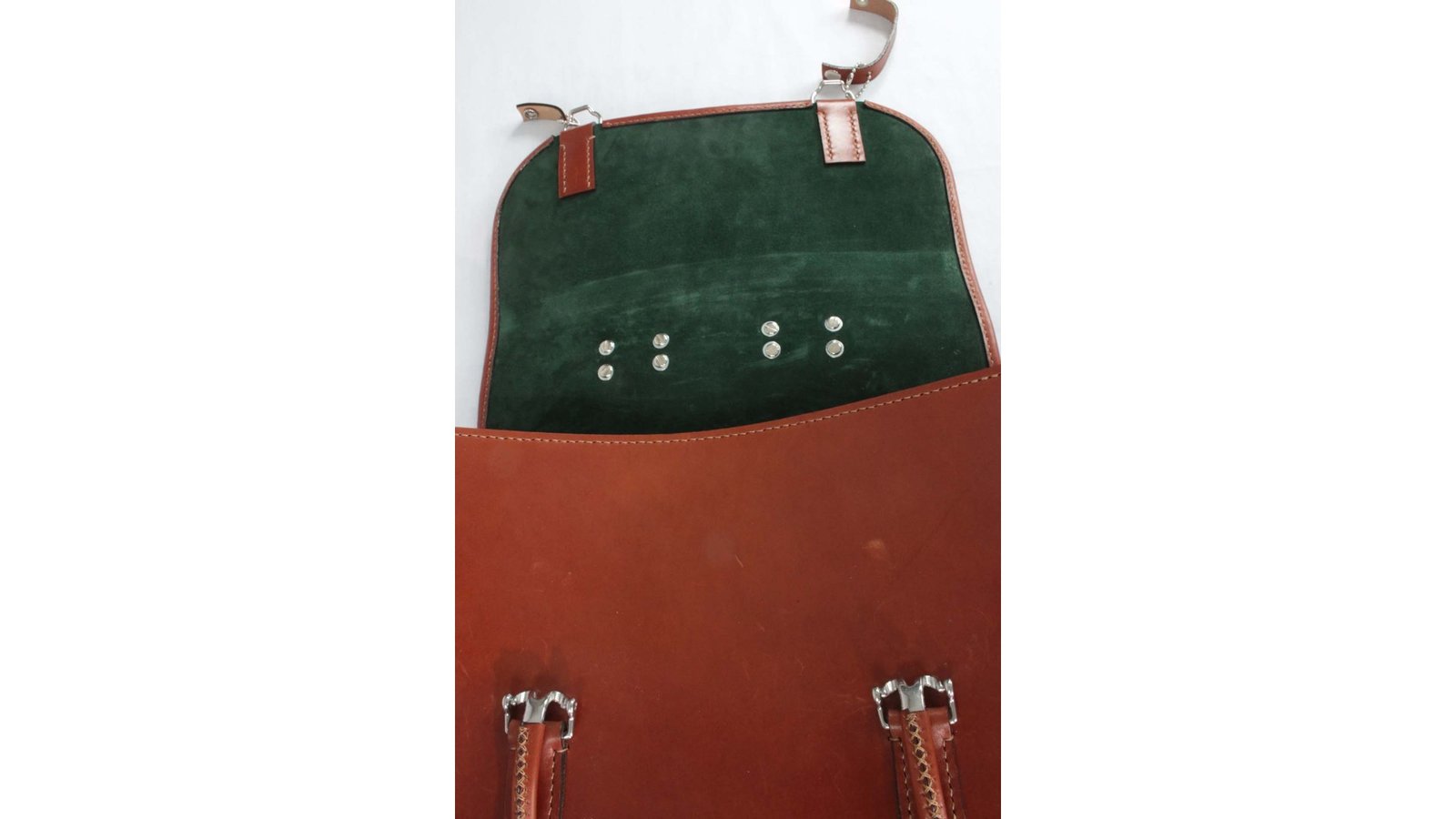
The photograph shows a case laid open. On the left, the russet front panel carries two buckle keepers with braided-looking stitching. On the right, the flap is turned back to reveal a dark green suede lining set with four pairs of silver screw heads. Around the flap’s perimeter, a narrow band of leather folds over to meet the lining, and a line of stitching sits just inside it.
That folded band is the subject. On a case like this, the edge is not cut and finished; it is turned.
Marcellino NY Briefcase Maker on YouTube: how to hand burnish vegetable-tanned leather edges.

Three ways to finish an edge
Every cut piece of leather has an edge that must be dealt with. Makers generally choose among three approaches, and one maker’s journal sorts them plainly: painted edges are built up in layers of paint, while turned edges are skived thin and folded over to hide the raw edge (Frayda). A third, the burnished edge, relies on friction alone.
- Burnished. The raw edge is sanded, wetted and rubbed until the fibers compress and glaze. A craft supplier’s guide says this seals the raw, cut edge and creates a water-resistant barrier, and notes that burnishing darkens the edge slightly and leaves a gloss.
- Painted. Layers of edge paint are applied and sanded between coats. The same journal describes the result as clean and modern.
- Turned. The leather is thinned at its perimeter and folded back on itself so the grain surface wraps the edge.
The flap in the photograph belongs to the third group.
How a turned edge is made
A retailer’s journal gives the sequence in plain terms. The maker thins the perimeter to a fraction of a millimetre, folds it back over itself, often around a filler, and stitches it down (Pampeano). The result is a seamless transition in which the grain of the leather runs continuously around the edge.
On a forum, a leatherworker lists the demands in shorthand: the skive has to be even, the fold has to be caught by the stitching, and each stage has to be right before the next begins. Another contributor says the method on cheap goods is simply ultra-thin leather folded over stiffening materials and non-leather backers, which is a useful warning: the look alone does not tell the construction.
Both are forum comments, not trade sources. They are included because they match what the specialist journals say.


Why choose a turned edge
The case for it is cleanliness and softness. A luxury-goods magazine describes a turned edge as one that is a turned edge has no paint film to crack and ages at the same rate as the panels beside it (Luxury Travel Magazine). On a flap, which opens and closes thousands of times, that matters: a painted edge can crack along the fold line, and a turned edge cannot.
A watch-strap specialist makes a related claim, saying the technique hides raw edges and so the strap is less prone to wear, fraying, or splitting. That is a seller’s argument and should be read as one.
The argument against
The other side comes from a British belt maker, which says that to create a turned edge, the leather must be the leather must be thinned to a sliver, and an edge that thin can wear through over time (Tanner Bates). The same company prefers a cut edge, sanded with finer and finer emery cloth up to 1200 grit and burnished.
Both claims can be true. A turned edge on a thin wallet carries little load. A turned edge on a heavy, thick bridle leather case is a different structure. The thinner the fold, the less leather there is to wear.
The thickness of the leather decides. The post on edge paint or burnished edges sets out the choice for thick bridle leather, where painted and burnished edges are the usual pair.
What the photograph tells you
Three observations are possible from the image itself.
- The fold is narrow and even. A wandering band suggests a hurried skive.
- Stitching sits close inside the fold. The thread catches the folded layer and the panel beneath it together, which is the point of the construction.
- The corner is rounded. Turned edges cope better with curves than with sharp corners, because the folded leather has to gather as it turns.
The silver screw heads on the lining, set in two columns, belong to something else, probably a fixing for an internal fitting. The photograph does not show what.
A note on labor
Turned edges cost time. Skiving, gluing, folding and stitching all happen before a case can be assembled, where a burnished edge can be finished at the end with sandpaper and a wooden roller. A rolling tool of that kind appears in the maker’s video on using a Weaver wood roller to burnish briefcase flap edges.
For anyone preparing edges before burnishing, the post on sanding edges before you burnish covers the first stage.
Sources
- Frayda, Edge Painting: The Invisible Detail: https://frayda.pages.dev/journal/edge-painting-the-invisible-detail/
- Pampeano, The Importance of Edge Finishing in Leather Goods: https://us.pampeano.com/blogs/journal/the-importance-of-edge-finishing-in-leather-goods
- Sailrite, How to Finish Leather Edges: https://www.sailrite.com/how-to-finish-leather-edges
- Tanner Bates, Maker Techniques: Leather Edges: https://tannerbates.co.uk/blogs/news/maker-techniques-edges
- Luxury Travel Magazine, The Bag That Comes Back Better: https://www.luxurytravelmagazine.com/news-articles/the-bag-that-comes-back-better
- Soturi, Turned-edge technique: https://soturi.squarespace.com/bulletin/turned-edge-technique
- r/Leathercraft (forum, anecdotal): https://rl.blitzw.in/r/Leathercraft/comments/1c5dskm/how_do_they_do_this_without_edge_paint
- Marcellino NY Briefcase Maker, How To Hand Burnish Vegetable Tanned Leather Edges (YouTube): https://www.youtube.com/watch?v=3wt9vExkVjQ
- Marcellino NY Briefcase Maker, Using A Weaver Wood Roller To Burnish Briefcase Flap Edges (YouTube): https://www.youtube.com/watch?v=D3c5L5Upkfc
- Marcellino NY, Edge Paint or Burnished Edges: https://marcellinony.com/edge-paint-or-burnished-edges/
- Marcellino NY, Sanding Edges Before You Burnish: https://marcellinony.com/sanding-edges-before-you-burnish/


