
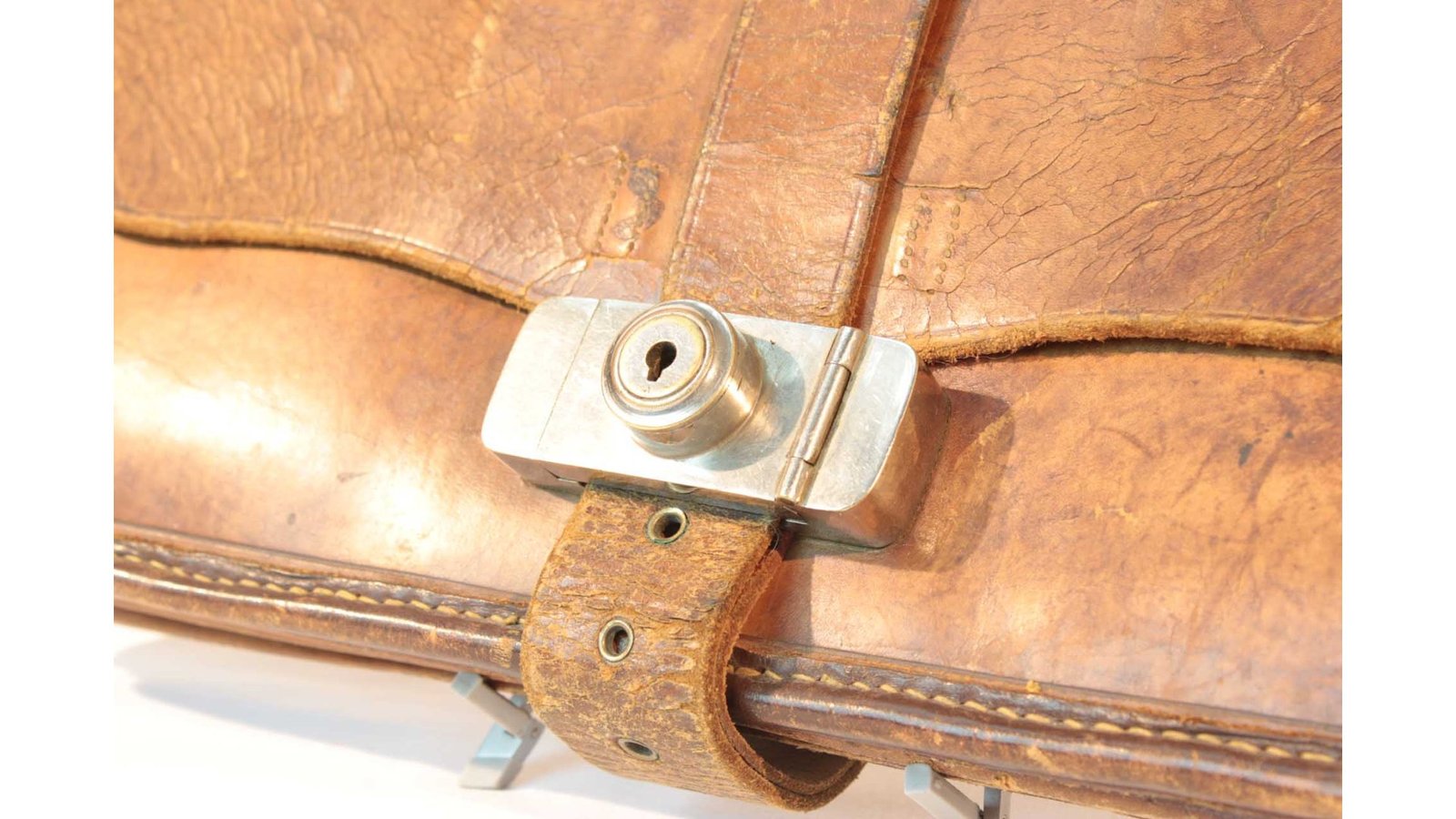
The photograph is a close-up of a brown leather case that has seen a lot of hands. A rectangular nickel lock sits at the center, a keyhole in its round barrel. Below it, a worn strap loops through, with three small brass-ringed eyelets punched along its length. Heavy stitching runs along the lower edge in a cream thread gone dull with age. The surface of the leather is a map of fine cracks.
Marcellino NY Briefcase Maker on YouTube: a natural vegetable-tanned briefcase forming a patina.

Every part of the image can be read. None of it needs a label to tell where the case sits in time.
The grain tells the leather’s history
The surface of the case is crazed with fine lines, and the leather has gone from its original shade to a deep honey-brown that deepens toward the edges. That change is chemical as well as cosmetic. A technical dictionary entry on vegetable-tanned leather notes that uncolored vegetable-tanned leather darkens with light, moisture and fat, and that fat first darkens the surface and then dries out, leaving it paler again over time.
The crazing is the other half of the story. Leather that has been flexed over decades, dried and re-oiled and dried again, develops a network of cracks in the grain. In the photograph the cracks are shallow and wide-meshed on the flap and finer toward the strap. They are where the grain has stopped stretching.
That does not mean the case has failed. A surface crack in the grain is not the same as a break through the hide. The test is whether the leather still folds without splitting, and a photograph cannot tell. A hand can.
The lock is its own timeline
The nickel lock in the photograph is a slim, squared-off box with a cylinder barrel for the key and a hinged plate that closes over the strap. Nickel plating shows its age differently from brass. Where the finish has worn, nickel gives up its shine and becomes dull silver; brass turns warm and dark.
The lock here has kept its brightness. Either it was well cared for, or it was replaced at some point. Both are common on old cases, and a good inspection looks for tell-tale signs: fresh holes in older leather, mismatched screws, a lock that sits a fraction off the strap line.
The Marcellino NY guide to fitting a lock to a case without misalignment explains why a lock must be set exactly square. On a replaced lock, misalignment is often the first hint.


The strap and its eyelets
The strap below the lock is the most worn part of the picture. Its edge is frayed, its grain is flaked and rubbed, and the three eyelets along it have the dull gleam of brass that has been handled for years.
Straps wear first because they are the part a hand touches every time. They also show whether a case has been repaired. Original eyelets sit cleanly and match one another. Added holes look different: they are rougher, they have no ring, and they are often slightly out of line with the others.
On the strap in the photograph, the three eyelets look consistent. That points to an original strap, though the picture alone cannot prove it.
Stitching that outlasts the owner
Along the lower edge, a double row of saddle stitching runs on a beveled, burnished edge. The thread is still intact across the span shown. Hand saddle stitching, in which two needles pass through each hole from opposite sides, lets each stitch hold independently. If one thread breaks, the others keep the seam closed.
That is why old stitching often outlives old glue and old hardware. The Marcellino NY post on why solid brass hardware outlasts the leather makes a similar argument about metal, and the same holds for a line of well-set thread.
Where this shape comes from
The photograph does not show the whole case, so its exact pattern cannot be named from the picture. The wider family of hinged, frame-built leather bags it belongs to has a recorded history. An Australian medical-history article credits the Gladstone bag to J. G. Beard, a London leather dealer, in the mid-nineteenth century (RACGP). It was named for the prime minister William Gladstone and stayed in use for more than a century.
Gladstone bags are the cousins of the lawyer’s case. The wide-opening shape that suited a doctor’s instruments also suited a barrister’s papers. A modern example, the Saddleback Barrister’s Briefcase, is described by its maker as designed for lawyers and uses the same hinged Gladstone closure.
For a modern equivalent built around a lawyer’s working needs, see the post on a briefcase for lawyers and legal-size files.
What to check before buying an old case
An antique case is worth reading before it is worth owning. A short list keeps the questions in order:
- Flex the flap gently at the fold. Cracks in the grain are common; splits through the leather are not acceptable.
- Look at the lock and its screws. Matching hardware, original holes and a square fit are good signs.
- Check the strap and its stitching. Frayed edges are cosmetic; cut threads along load-bearing seams are structural.
- Smell it. A damp, sour smell suggests stored moisture and possible mold in the lining.
- Ask for the key. Many old locks lose theirs, and replacing a cylinder is slow work.
Sources
- Leather Dictionary, Vegetable-tanned leather: https://www.leather-dictionary.com/index.php/Vegetable-tanned_leather
- Royal Australian College of General Practitioners, A historical account of the doctor’s bag (Australian Family Physician, 2016): https://www.racgp.org.au/the-racgp/history/history-of-general-practice/a-historical-account-of-the-doctor-bag
- Saddleback Leather, Gladstone Collection: https://saddlebackleather.com/gladstone-collection
- Marcellino NY Briefcase Maker, Natural Vegetable Tanned Leather Briefcase Forming a Patina (YouTube): https://www.youtube.com/watch?v=33BG3j8KdLE
- Marcellino NY, Fitting a Lock to a Case Without Misalignment: https://marcellinony.com/fitting-a-lock-to-a-case-without-misalignment/
- Marcellino NY, Why Solid Brass Hardware Outlasts the Leather: https://marcellinony.com/why-solid-brass-hardware-outlasts-the-leather/
- Marcellino NY, Briefcase for Lawyers and Legal-Size Files: https://marcellinony.com/briefcase-for-lawyers-legal-size-file/


