
Open any edge-finishing guide and the first step is the beveler. Tandy’s guide to mastering leather edges puts it as a pro tip: always bevel before dyeing or burnishing. On most of my briefcases, I don’t.
That video is the exception, and it is in the post on purpose. A disclosure belongs up front too: I make and sell English bridle leather briefcases as Marcellino NY, and the edges I’m describing are on those cases. I’ve worked leather since 1995 and been paid for it since 2010, and the edge is still the part people touch first.
What a beveler is for
A beveler shaves the square corner off a cut edge. You push it along at an angle and a thin curl of leather comes away, and what’s left is a softer shoulder instead of a right angle. Then you sand, wet it, and rub it with a slicker until the fibers heat up and lie down. A round edge burnishes better than a square one because there’s less corner to fold over and fray.
That’s all true. If I’m burnishing, I bevel.
The video shows a conker bridle panel that was going to be left open and burnished with gum paste. I beveled the whole outside of the main panel, then only the inside of the flap where it folds over and touches. Where the gussets meet the panel, I left the edge flat, because those layers have to sit tight against each other when I stitch them.
The paint builds its own edge
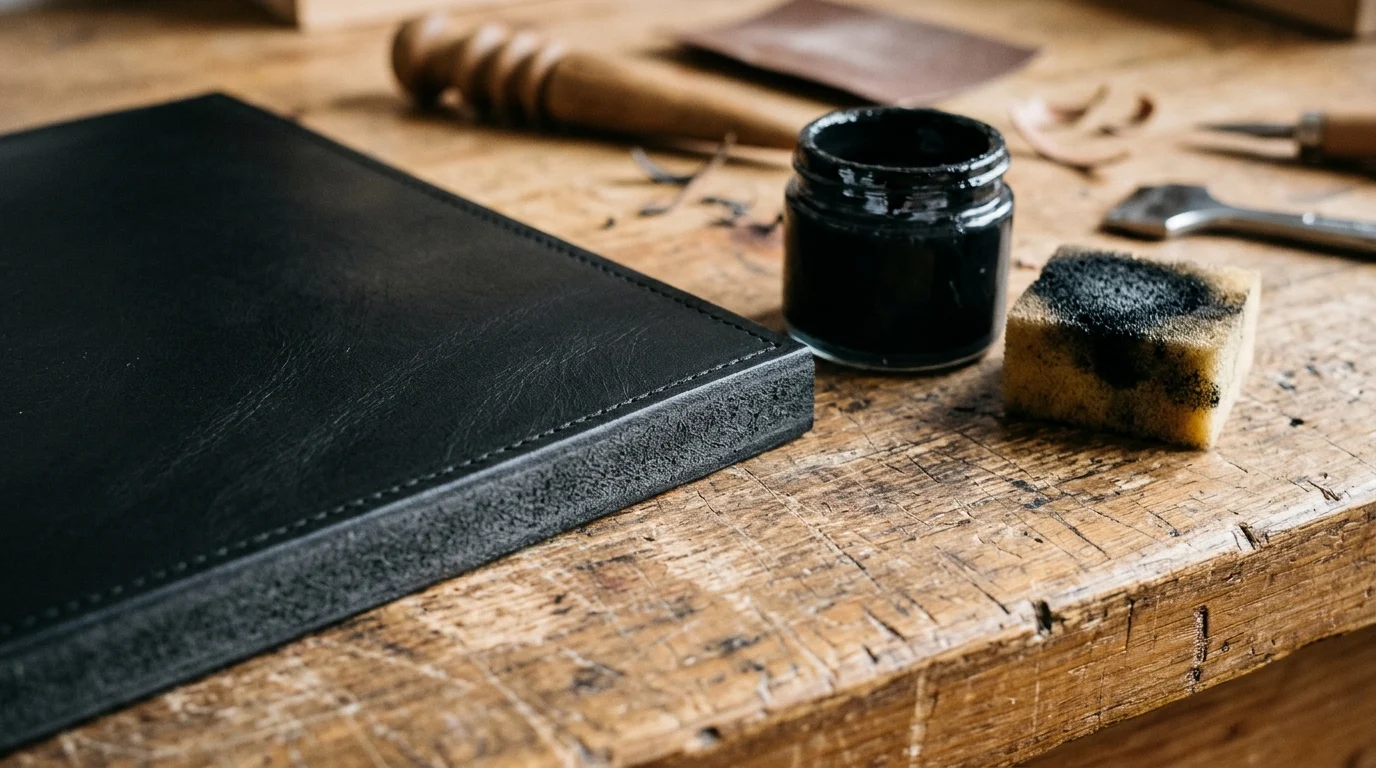
Most of my cases get a latex-based edge paint instead. Five, six, seven coats, counting a solid base coat underneath. Each coat goes on with a sponge, dries, and goes on again. Between coats I take a hot iron to the bumps and melt them down.
After five coats the paint does something useful. It doesn’t sit flat on the edge; it rides up a little at each corner every time, and by the fifth coat it has rounded the edge on its own. The coats build the bevel. Cutting one in first is doing the same job twice.
Sailrite’s guide to finishing leather edges lands in the same place from the other direction: because painted edges aren’t burnished, you don’t have to bevel for the sake of the finish. And Tandy’s own edge-finishing tutorial, the same company that says always bevel, notes that some people choose not to bevel when painting. I’m one of them.

A flat edge holds the paint
There’s a second reason, and it’s the one that matters on thick English bridle.
Bevel that edge and you’ve made a slope. Paint likes to run down a slope. Every coat wants to creep off the shoulder and onto the face of the leather, and then you’re cleaning paint off the grain with a damp rag while the next coat is waiting.
Leave the edge square and the paint has a flat floor to sit on. It stays where you put it. On thick English bridle, which is dense and waxy and often several layers deep at a seam, that flat floor is the difference between seven clean coats and seven coats you fought.
Thinner leather is a different conversation. So is a bag that’ll be burnished. It depends on the leather, the thickness and the briefcase, and I can’t say I never bevel a painted edge. I usually don’t.
Why paint at all on a lined case
Some of my cases are lined in suede or in a second layer of bridle. Put a raw edge on one of those and you can see every layer: the face, the lining, sometimes a different color in between. Burnish it as hard as you like and those lines still show, and the fibers of the lining never get as smooth as the face.
Edge paint covers that. One black line from top to bottom. It also does a job you can’t see: the paint is a binder, and it glues the layers together at the edge, which keeps the lining from lifting.
So on a lined case, paint isn’t decoration. It’s part of how the edge holds.

Where the argument turns against me
Paint chips. I’m not going to pretend it doesn’t.
Drag a painted case across a concrete step enough times and the edge will open up somewhere. Burnished edges wear too, but they wear like leather: they go a little rough, and a slicker and some gum bring them back. A chip in paint is a chip until someone fixes it.
I’ve said it on video and I’ll say it here. Treating one of these briefcases like a gym bag is like going jogging in a bespoke suit. They’re built to be carried, not thrown. But people do throw them, and an honest maker has to admit the burnished edge forgives that better than the painted one does.
The fix for paint is easy, at least. I use flat black because in my experience it holds up longer than gloss. A small bottle of latex edge paint and a cotton swab will touch up a chipped corner the same way polish touches up a scuffed shoe.
Ten seconds of thinking before the beveler comes out
So the decision on my bench runs like this. Is the edge getting burnished or painted? Is the leather thick English bridle or something thinner? Is the case lined, so the paint has to hide layers and glue them?
Burnished: bevel, sand, slick. Painted, thick, lined: leave it square and let the coats do the rounding. The guides aren’t wrong. They assume a burnished edge, and Tandy’s first step says so.
There’s more on choosing one finish over the other in Edge Paint or Burnished Edges, and on picking the tool itself in Choosing an Edge Beveler. If you’ve got a stack of thick bridle on the bench and a beveler in your hand, try one edge each way and paint them both. Run your thumb down them after the fifth coat.

Sources
- Tandy Leather, Mastering leather edges: beveling, burnishing and polishing: https://tandyleather.com/blogs/tandy-blog/mastering-leather-edges
- Tandy Leather, Tandy Skills: edge finishing tutorial: https://tandyleather.com/blogs/tandy-blog/tandy-skills-edge-finishing-tutorial
- Sailrite, How to finish leather edges: https://www.sailrite.com/how-to-finish-leather-edges
- Video: Beveling Conker English Bridle Leather Briefcase Panel, Marcellino NY Briefcase Maker: https://www.youtube.com/watch?v=4k5GpvpBicI
- Video: Painting edges on black bridle leather briefcase, Marcellino NY Briefcase Maker: https://www.youtube.com/watch?v=YPHcrnInO-s
You might also like
- Edge Paint or Burnished Edges
- Choosing an Edge Beveler
- Sanding Edges Before You Burnish
- Hand Burnishing Edges on Vegetable-Tanned Leather


