
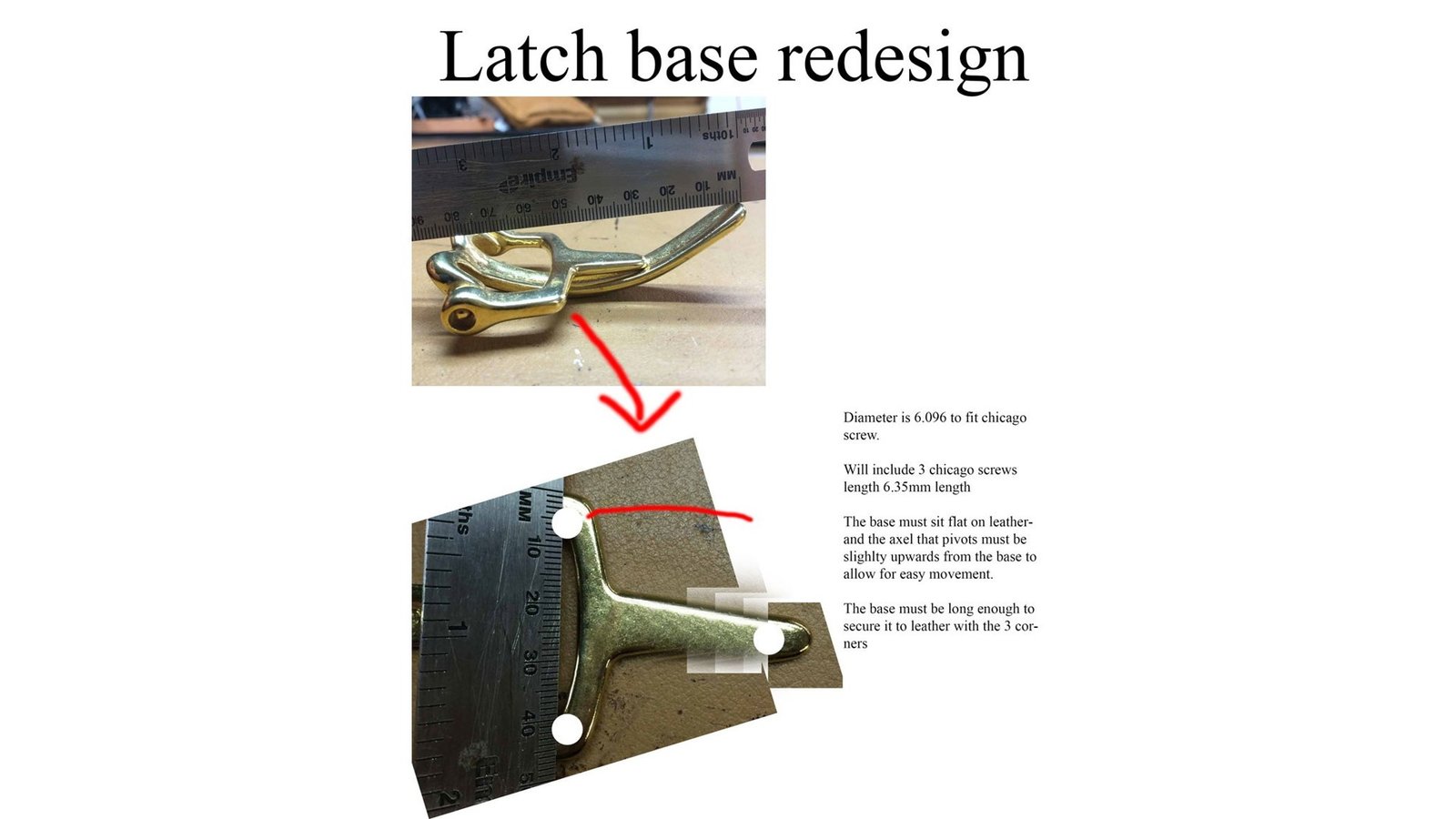
This is a working sheet, not a polished photograph. The heading reads Latch base redesign, a brass latch lies against a steel rule, and red arrows point to the places where a screw will go. The notes on the right are specifications for the base of the Marcellino latch.
Marcellino NY Briefcase Maker on YouTube: Marcellino Latch – How It Works.

What the sheet says
The sheet gives its requirements in plain lines. The hole diameter is 6.096 mm, sized to fit a Chicago screw. The base will include Chicago screws 6.35 mm long. This page says three screws, and the second page in the set says two screws of the same diameter and length, so the count was still being settled. The base must sit flat on the leather, and the axle that pivots must sit slightly upward from the base to allow easy movement.
The last note says the base must be long enough to secure it to the leather at three corners. White dots on the photograph mark those three points.
Why a flat base and a raised axle
The sheet gives the reason for the raised pivot in its own words: easy movement. The flat base is the part that sits against the leather and takes the three fixing points.
The latch pivots at one point and is stitched to the leather. That is the whole mechanism.


How the latch works
I designed the latch for lawyers. They liked the traditional brass locks but needed something fast to get in and out of a briefcase, and a buckle is slow. The hardware comes from the horse-tack trade. It took a couple of years of designs to settle the structure, the handle and the way it carries the load.
There is nothing in it to break. It pivots at one point, it is stitched to the leather, and I say in my video that it should last as long as the leather and the seams, around 50 years of average use, which is my estimate, not a test result.
Tighter when the bag is full
The latch grips tighter when a briefcase is packed. On thin leather it can rattle loose. On thick leather it does not. For a bag that is often empty I make a leather loop that wedges the latch, and it is removable, with a chain available too.
The photographs in the gallery show the base from several angles, and the last collage shows how a thumb holds a piece against the rule. This is how a part gets decided: by holding it, measuring it, and writing the dimension on the sheet.
Sources
- Marcellino NY Briefcase Maker, Marcellino Latch – How It Works: https://www.youtube.com/watch?v=BO_UK0oVNao
- Marcellino NY Briefcase Maker, The Original Marcellino Latch: https://www.youtube.com/watch?v=VFHK64TAax0


