
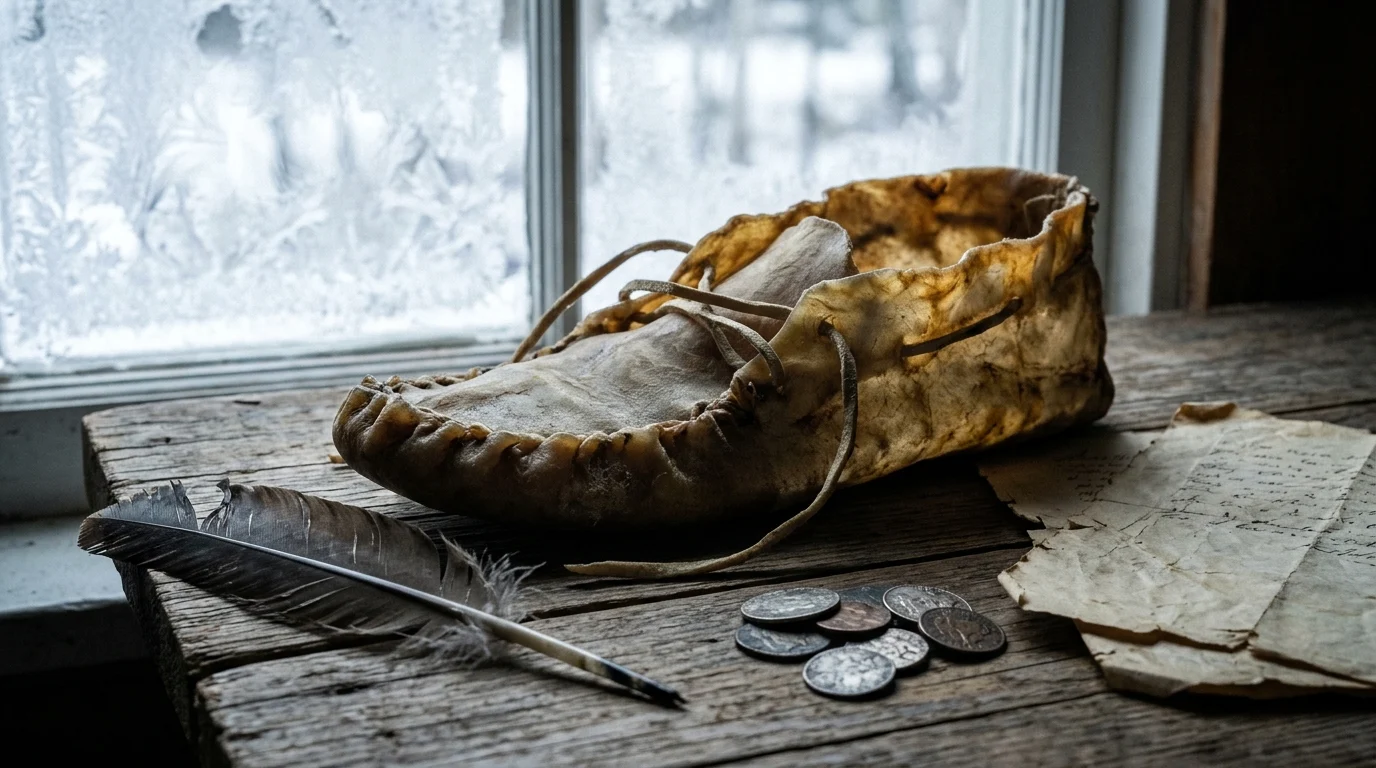
The deadline was nine o’clock on a Monday morning. On Saturday, November 22, 1777, at headquarters in White Marsh, Pennsylvania, the after orders of the day carried a prize notice from the commander in chief. Washington offered a reward of Ten dollars to any person who could, by that Monday, “produce the best substitute for shoes, made of raw hides”.
The Commissary of Hides would furnish the skins. The Major General of the day would judge the essays, as the orders call the entries, and, in the transcription at ushistory.org, “assign the reward to the best artist.” The editors of the Washington Papers note only that the following Monday was November 24. No winner appears in the document.
Two hundred and forty-nine years later, the order reads like a hackathon run by a general. It also reads like a confession, because a contest for shoes made of untanned skin is what an army announces when the tanned kind isn’t coming in time.
A Shoe Crisis Before Valley Forge
Barefoot on the ice, eleven days after the prize
The National Park Service, in its series on footwear at Valley Forge, gives the scale. Eleven days after the reward was offered, Lord Stirling reported that above one half of those in Camp were walking barefoot on the ice or frozen ground. In a letter of December 23, 1777, Washington counted 2,898 men in camp unfit for duty because they were barefoot and otherwise without clothing. The Park Service puts that at nearly a quarter of his army.

Washington’s men had marched into Valley Forge on December 19, according to the park, more than 12,000 soldiers and 400 women and children. Disease killed nearly 2,000 people over the encampment. The park’s overview page attaches the 2,898 figure to early March, as the worst point of the clothing shortage, so the same count appears in two places with two dates; both are Park Service pages, and both are given here.
Shoes were not one problem among many. The Park Service says Washington had more concerns over his army’s supply of shoes than over any other single article. The colonies had depended on Great Britain for most finished goods, shoes included, and patriots struggled to scale up production once the war cut that supply. French supplies, the Park Service says, varied in quality. Washington complained that the French shoes were generally too small, and that “they are thin French pumps that tear to pieces when ever they get wet.”
What soldiers needed, the Park Service says, was shoes of robust cowhide. That is a sentence about leather, and leather is a sentence about time.
The Hides Were Already There
A department, a year to the day
The army was not short of skin. It ate cattle, and cattle come wrapped in hides.
Congress had planned for that. According to the Encyclopedia of the American Revolution, revised by Harold E. Selesky and republished by Encyclopedia.com, Congress established a Hide Department on 22 November 1776 to take custody of “the original wrappings of cattle slaughtered for the army”. The commissary of hides was directed to exchange them for tanned leather or for shoes. He could set up tanyards and produce shoes himself, or contract out the work. George Ewing was appointed to the post on August 5, 1777.
The prize order came exactly one year after that department was created.
Ten days before the contest, Washington had put the arithmetic in a letter to the Clothier General, James Mease. He wrote that if the hides of the cattle consumed by the army were returned as leather, they would much more than shoe the Soldiers, and that proper steps should be taken to have it worked up. Elsewhere in the same letter, answering Mease’s report of how little clothing he had on hand, he wrote that “our prospects are melancholy indeed” unless considerable quantities were expected from abroad.
The raw material, in other words, was walking into camp on four legs. Turning it into something a soldier could march in was the bottleneck.
What a Tanner’s Calendar Looked Like
Weeks for a calfskin, years for an ox
Colonial Williamsburg’s craft booklet The Leatherworker in Eighteenth-Century Williamsburg, by Thomas K. Ford with Harold B. Gill Jr., sets out the eighteenth-century timetable. Careful and complete tanning, it says, required from several weeks for a light skin to eighteen months for a heavy hide. Counting every step from the animal’s back to finished leather in a shoemaker’s or saddler’s hands, liming and fleshing through the vats to currying, the booklet puts the total at anything from a few months for a lambskin to more than two years for a thick ox hide.

An earlier American record runs on the same clock. The Park Service’s account of tanning at seventeenth-century Jamestown describes a procedure which took about two months of alternate soaking and resting in lime to loosen the hair, then a second soak-and-rest in weak lime that “took over six months.” Only after that did the hides go into a pit, layered with oak, beech or willow bark under a foot of tanbark, trampled down and kept moist for three months. The stages the page dates add up to more than eleven months, before the currier ever touched the leather.
Set those calendars against the orders. Washington’s after orders gave the essayists until Monday morning: under two days. A shoe-sole hide in a bark pit in November 1777, on the Williamsburg reckoning, might not be finished until 1779.
Nobody in camp could wait for oak bark. Rawhide skipped the tanyard entirely, and that was the whole appeal.
Ewing’s Report: The Tanyards Were Running Late
144,376 pounds of raw hide, eighteen tanners
On December 2, eight days after the essays were due, the commissary reported in. “George Ewing’s Report on Hides,” preserved in the Washington Papers, accounts for 144,376 pounds of raw hide exchanged for leather and distributed among eighteen tanners since September 2.
The exchange rate is the most physical detail in the record: five pounds of raw hide for one pound of sole leather, eight pounds for one pound of upper leather. Run Ewing’s total through those ratios and the 144,376 pounds would come back as roughly 28,900 pounds of sole leather if it all went to soles, or about 18,000 pounds if it all went to uppers. (Calculation by this publication from the figures in Ewing’s report.) The report does not say how the hides were split between the two.
Then the line that explains the rawhide prize: most of that leather, Ewing wrote, “ought by contract to have been ready by this time.” It wasn’t. He had put a large quantity of hides out to be tanned, and he believed that if he could find more tradesmen, particularly tanners, he could dispose of all of them.
The report covers about three months of contracts. On the Williamsburg timetable, three months is enough for a light skin. It is not enough for the heavy sole leather an infantryman stands on, and a contract can’t argue a hide through the pits faster than the bark works.
The Moccasin Problem
Hard edges and a memoir written decades later
What did a rawhide substitute look like in practice? The best-known witness is the private Joseph Plumb Martin. In his 1830 memoir, as the Park Service recounts, he described making a pair of moccasins from raw cowhide before the march. The hard edges chafed his ankles. They also kept his feet off the frozen ground, and he wrote that the alternative was to go barefoot, as hundreds of his companions had to.

The Park Service connects Martin’s moccasins to Washington’s contest: he likely made them as part of the army’s larger, internal effort to shoe itself. Some soldiers had shoemaking experience, and commanders wanted a model that could be produced at scale.
The same agency punctures the legend. Martin’s famous image of men who “might be tracked by their blood upon the rough frozen ground” comes from a memoir published in 1830, more than fifty years after the winter, and the footwear article says plainly that it is not known whether Martin personally saw his comrades’ feet bleeding. The park’s own overview goes further, calling the picture of troops in rags leaving bloody footprints in the snow not necessarily accurate.
Against that, other evidence, the article says, supports Martin’s account of makeshift moccasins, and Stirling’s and Washington’s own counts of barefoot men were written that winter, not in retirement. The fair reading holds both: the blood may be literary, the bare feet were in the returns.
On the contest itself, the park adds a caution: even if Washington had success with the idea, it would still take time to implement. A good design on Monday morning was not 2,898 pairs on Tuesday.
Rawhide Against Leather
The difference is the whole trade
Tanning is what separates a hide from leather, and in the eighteenth century it was slow by any measure. The Williamsburg booklet describes the hide or skin soaked in a series of vats, each with a stronger solution of tan liquor, called “ooze,” than the one before. At Jamestown the bark pit alone took three months, and that came after the better part of a year in lime. Nobody in either account rushes it.
Rawhide is what the army got by skipping that sequence. The surviving testimony of how it wore is Martin’s: hard at the edges, rough on the ankle, better than nothing. The army ran the contest anyway, because better than nothing was the bar that November.
Marcellino NY makes and sells bridle leather goods, so this is its own trade talking, and the point is narrow: what a two-day contest couldn’t buy in 1777 was months in the pit.
Ewing’s shortage, by his own report, was tanners, not hides; he already had a numerous quantity out to be tanned. The army marched into Valley Forge 25 days after the prize deadline, and any heavy hide from the cattle it ate that winter faced the same slow liquor, to be ready, on the booklet’s eighteen-month figure, sometime in 1779.
You Might Also Like
- Inside the Chouara Tannery in Fez: How Leather Is Made
- What ‘Made in USA’ Means on a Leather Bag
- Where to Buy Leather as a Beginner
Sources
- “General Orders, 22 November 1777,” Founders Online, National Archives (George Washington Papers): https://founders.archives.gov/documents/Washington/03-12-02-0342
- “General Orders, November 22, 1777,” Virtual Marching Tour, ushistory.org: https://ushistory.org/march/other/genorders1122.htm
- “George Washington to James Mease, 12 November 1777,” Founders Online: https://founders.archives.gov/documents/Washington/03-12-02-0215
- “George Ewing’s Report on Hides, 2 December 1777,” Founders Online: https://founders.archives.gov/documents/Washington/03-12-02-0471
- National Park Service, “Tracked by Their Blood Upon the Rough Frozen Ground” (Valley Forge Underfoot, part 3), updated March 18, 2021: https://www.nps.gov/articles/000/valley-forge-footwear-3.htm
- National Park Service, “Supply Challenges” (Valley Forge Underfoot, part 2), updated March 18, 2021: https://www.nps.gov/articles/000/valley-forge-footwear-2.htm
- National Park Service, Valley Forge National Historical Park, “What Happened at Valley Forge”: https://www.nps.gov/vafo/learn/historyculture/valley-forge-history-and-significance.htm
- National Park Service, Historic Jamestowne, “Tanning in the Seventeenth Century”: https://home.nps.gov/jame/learn/historyculture/tanning-in-the-seventeenth-century.htm
- Thomas K. Ford, with Harold B. Gill Jr., The Leatherworker in Eighteenth-Century Williamsburg (Colonial Williamsburg), Project Gutenberg text: https://dev.gutenberg.org/files/58293/58293-0.txt
- “Supply of the Continental Army,” Encyclopedia of the American Revolution: Library of Military History, revised by Harold E. Selesky, via Encyclopedia.com: https://encyclopedia.com/history/encyclopedias-almanacs-transcripts-and-maps/supply-continental-army


