
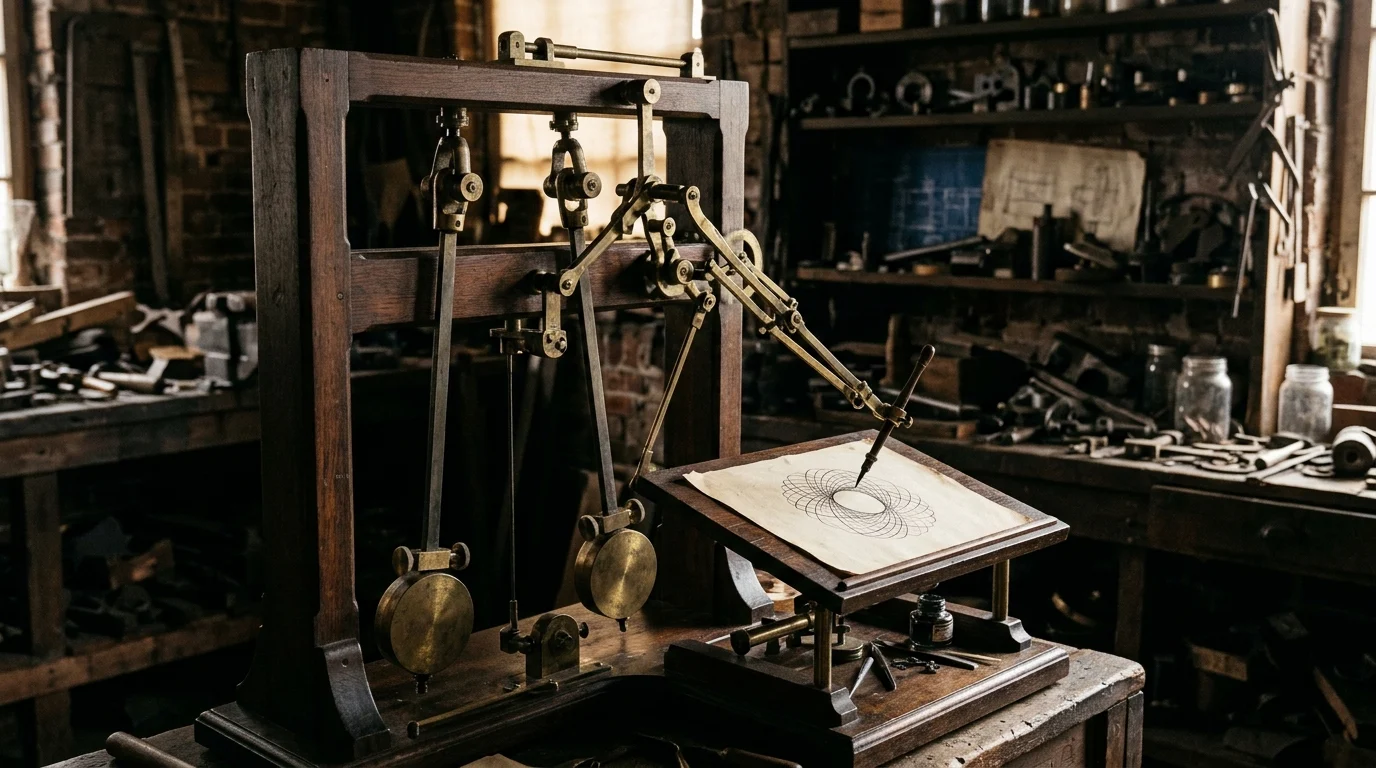
A harmonograph draws with weight. Two heavy pendulums swing at right angles, one carrying the pen and the other the paper, and the combined motion leaves a looping line that no hand would place. The line thins as friction takes the swing, and the drawing ends when the pendulums stop.
A Victorian drawing machine
The Science Museum Group dates harmonographs to the 1870s and describes them as machines that used the motion of pendulums to draw curves. Its collection holds a wood-and-metal example by Arthur Edward Donkin, who designed a version in 1873 that used gears and wheels in place of pendulums. The same record says harmonographs were used as lecture and laboratory demonstrations and in the study of sound.
Credit for the idea is unsettled. Hugh Blackburn, a mathematics professor at Glasgow, is commonly named as the inventor, but Wikipedia notes the devices cannot be conclusively attributed to one person and that they peaked in popularity in the 1890s.

Parlor entertainment, with a mechanism
Gizmodo describes the harmonograph as a Victorian party device, with printed guides showing which swings produced which patterns. The appeal is easy to see: a wooden frame, brass weights and a pen, and a result that looks designed.

Where the curves come from
Each pendulum contributes a sine wave. With two at right angles, the pen traces a Lissajous figure, and the ratio of the two frequencies sets its shape. The MacTutor biography of Jules Lissajous records that in 1855 he described studying vibrations by reflecting a light beam from a mirror on the vibrating object, and that he produced his figures by bouncing light off mirrors on two tuning forks vibrating at right angles.
The Whipple Museum adds that the forks were part of an apparatus used to calibrate forks during manufacture and in the French effort to fix a standard concert pitch in 1858.

Making the drawing yourself
A live version runs in the browser at apps.x9m8.com/harmonograph, built by the same owner as Marcellino NY. It switches between the closed Lissajous loop and the decaying harmonograph spiral, with preset ratios such as 3:2 and 5:4, and a Full screen button. The physics is written up on x9m8.com.

Sources
- Science Museum Group: Donkin’s Harmonograph
- Gizmodo: The harmonograph was the first art machine
- Wikipedia: Harmonograph (used for the Blackburn attribution and popularity dates)
- MacTutor: Jules Antoine Lissajous
- Whipple Museum: Lissajous Tuning Forks


