
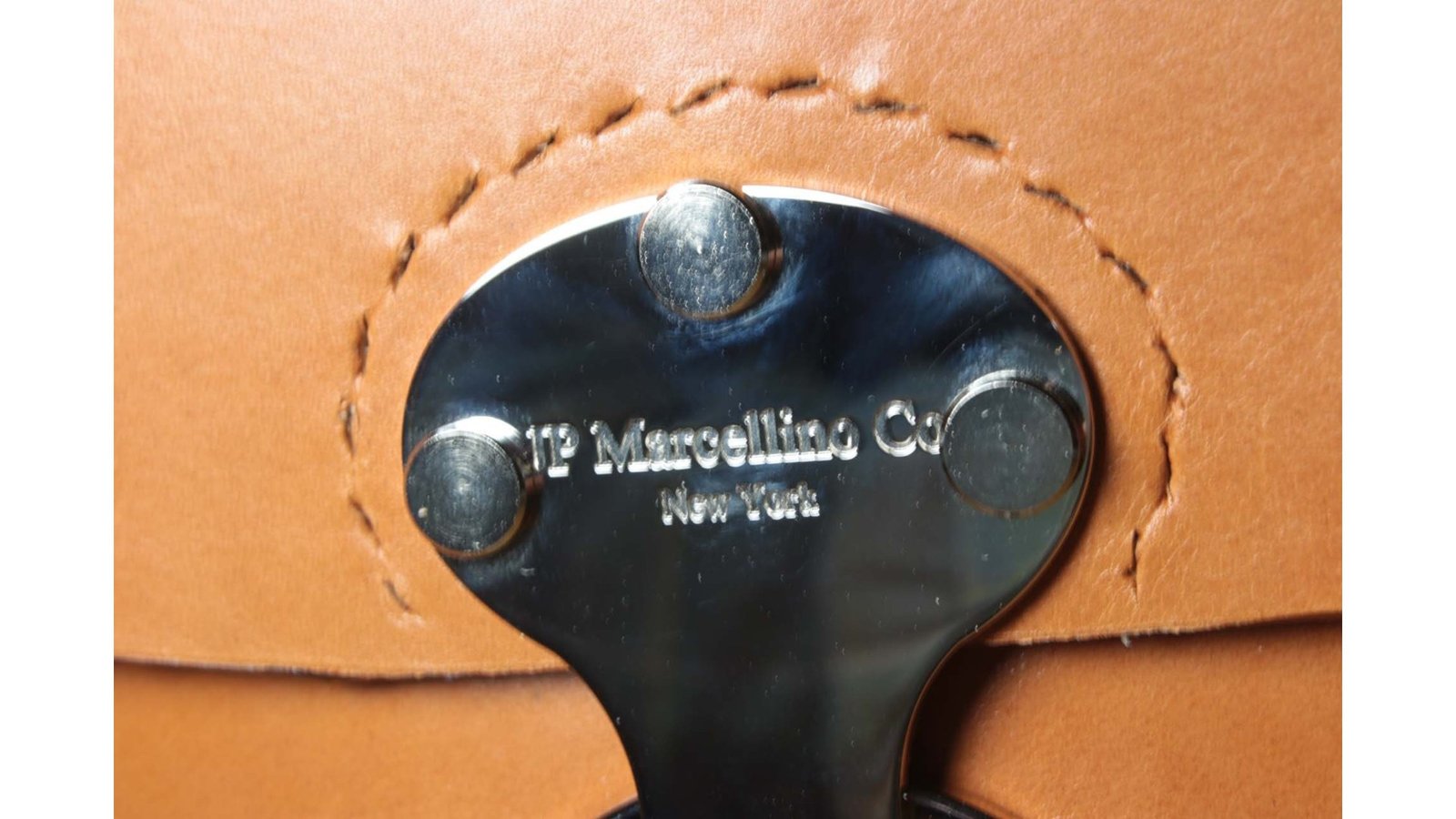
Three round bolt heads sit on a nickel plate in the first photograph, and the plate carries my name and New York stamped across its face. Behind it is tan leather, and around it a ring of hand stitches in the shape of an oval. That stitched outline is easy to miss. It is part of how the lock stays on the bag.
Marcellino NY Briefcase Maker on YouTube: Chestnut and Black English Bridle Leather Briefcase – Wallace Style.

What the photographs show
The plate is not screwed to the surface and it is not clipped on with prongs. The bolt heads go through the flap, and what shows on the other side is a second plate. In the angled shots the upper plate and the larger round plate below it both carry the same ring of heads, and the leather is clamped between them.
The oval of stitching around the upper plate holds the leather down around the cutout. A lock sits in a hole, and a hole weakens the leather around it. Sewing a border there keeps the edges of the cut from spreading.
Rivets, prongs and screws
I have put locks on briefcases three ways over the years. On handbags I use prongs, which is the modern, easier method, and I set the prongs well. On a briefcase I go the old way, with no prongs and no screws. Rivets pass through the holes in the lock and through the leather, and that gives the tightest grip I know of. In my own words from one of my videos, when a lock goes on a briefcase and it has to last, it goes on with rivets.
Not every rivet is equal. A hollow tubular rivet is the weakest of the types I have worked with. A solid tubular one is stronger. Copper is strong too, though I do not like how it looks on a bag I am building. The video linked above goes through the lock types and why I land on rivets for a heavy case.


Why the leather matters as much as the metal
A lock on a flap gets opened and closed more than any other part of a briefcase, and the pull lands on the same few holes every time. If the lock is fixed with a single screw and a washer on the back, the screw is what takes that pull. Rivet heads spread the load across the leather and the plate together.
In my video I make the same point about cheap pot-metal locks, the painted tin kind: they are not built for a working lawyer who beats a briefcase up, and the hardware is the part that gives out first.
Setting rivets by hand
The rivets arrive long. I cut each one down and hammer it flat, one at a time so everything stays even. Light taps, repeated, until the metal warms and flattens. A hard hit bends the nail, and a bent rivet two or three in is a repair I would rather not make. Once the plate is secured I cannot get it off without a Dremel, and that risks the plate, the lock and the leather together.
So the work goes slowly. Leather is expensive and the lock is expensive, and there is no step in the process where a mistake is cheap.
Reading a lock plate on any bag
Turn the flap over. If bolt or rivet ends show on the inside, with a plate or a lining covering them, the lock goes through the leather. If the back is smooth and the front shows nothing, it is clipped or glued from one side. Neither tells the whole story of the bag, but it tells how the maker expected the lock to be used.
Sources
- Marcellino NY Briefcase Maker, Chestnut and Black English Bridle Leather Briefcase – Wallace Style: https://www.youtube.com/watch?v=GPjoWx–bp0
- Marcellino NY Briefcase Maker, Hand Stitching vs Rivets: https://www.youtube.com/watch?v=EnuUpxMN8QQ


