
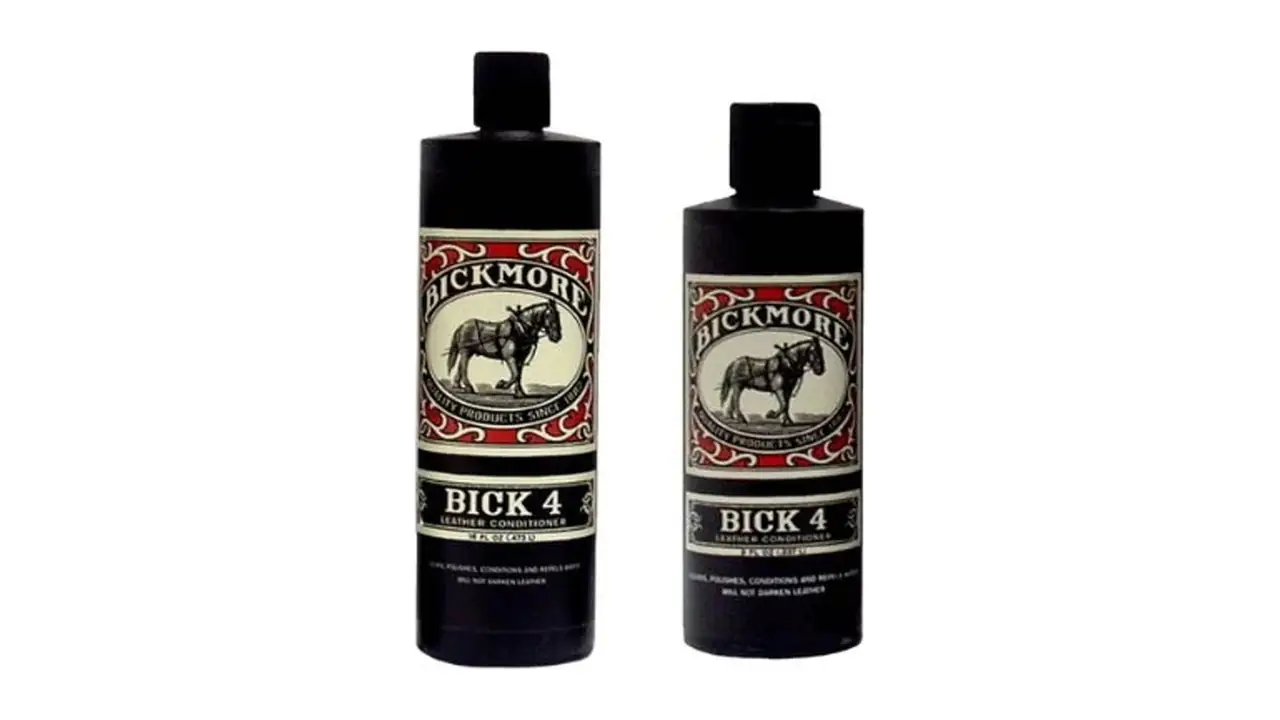
Every leather shop in America has a tub of Bick 4 somewhere. Mine has had one on the shelf for as long as I’ve been cutting bridle. It sits next to the edge paint and the beeswax, half-used, lid a little sticky, and it’s still there for one reason. It does one job better than anything else I’ve tried.
That job is not the one on the label.
Back in 2018 I sat down in front of a camera and tore into it. I said it doesn’t feed leather, it smells like a chemistry set, and it comes with no ingredients list. I meant every word. I also kept using it, and the reason I kept using it is the reason this review exists.
What Bick 4 Says It Is
Bickmore has been making leather care since 1882, according to its own Amazon listing, and Bick 4 is the flagship. The company sells it as a conditioner and cleaner for just about anything with a hide in it: boots, jackets, handbags, saddles, car seats, couches. Three claims carry the pitch. It won’t darken your leather. It’s completely wax-free, so it won’t seal up the pores. And it goes on in one step.
All three are true as far as I can tell. Two of them are exactly why it fails as a feed, and one of them is exactly why I still buy it.

The Bloom Problem Nobody Warns You About
English bridle leather comes out of the tannery stuffed with wax and tallow. That’s the whole point of it. Harness makers needed straps that could take rain, sweat and a horse leaning on them for twenty years, so the tanneries packed the fibers until the hide could shrug off weather. When the leather sits, some of that wax works its way to the surface and leaves a pale, hazy film. That film is the bloom.
I like the bloom. It tells anyone who knows leather that this isn’t the corrected-grain stuff they sell at the mall. If you want to read more about why it matters, I covered it on the traditional English bridle leather briefcase page.
Customers don’t always agree. A man buys a black briefcase for a board meeting and he wants it to shine like a hearse. He sees white haze on the flap and figures something’s wrong. Something isn’t. But I still have to get that haze down before it ships, and I have to do it without stripping what the tannery put in.
Where Bick 4 Earns Its Shelf Space
This is the one job. The cream picks up that top layer of wax and carries it off on the rag, and the leather underneath comes up with a clean, even sheen. No blotches. No dark patches where you pressed too hard. That “won’t darken” claim isn’t marketing fluff here. On a finished black or a London tan, darkening is the last thing you want when all you’re after is a polish.
Here’s how I use it on a bridle briefcase:
- A small dab on a clean cotton rag, never straight onto the leather.
- Light circles over the hazy areas, working one panel at a time.
- A dry rag right behind it to buff off what lifted.
- Gloves on. More on that below.
Five minutes and the flap looks like the customer pictured it. A couple of years ago I filmed it on a black Habermas, bringing the waxy haze down before the case went out the door:
That’s the right tool for the right job. The trouble starts when people think it’s doing a second job.
Why It Doesn’t Feed Leather
Leather needs oil. That’s the food. Wax sits on top and keeps water out, but oil is what gets down into the fibers and stops them from drying, stiffening and eventually cracking along every fold. A briefcase flap bends a few thousand times a year. Starve it and it splits like an old garden hose.
Bick 4 is a cream. Somebody took a little oil, a lot of water and whatever else, emulsified it, and turned it into something that feels like hand lotion. It goes on easy. It feels like you’re doing something. And on a good piece of vegetable tanned leather, it mostly doesn’t go anywhere.
I ran the test on camera. One half of a natural veg tan piece got a wax and oil paste. The other half got Bick 4. The paste side darkened right away, which is how you know oil is going in. The Bick side looked a little shinier for a minute, then dried back to where it started. In my words from that video: “If it’s not darkening, it’s not penetrating.”
That’s the catch with “won’t darken.” A conditioner that never darkens leather isn’t putting much in. Natural veg tan drinks anything you give it, so if a product can’t move the color on that, it isn’t feeding the hide. I’d guess most of it ends up in the rag.
Part two picked up where the camera cut out. Ten minutes later, the paste side had soaked in and dried down with no residue. The Bick side looked exactly like nothing happened, because nothing much had.

The Ingredients List That Isn’t There
Turn the tub around. You won’t find what’s in it. Bickmore tells you what it does and leaves the contents to your imagination, and they’re not alone. Most of the big conditioner brands do the same thing.
I have a problem with that. I can fill a bottle with tap water, print “restores and protects” on it, and nobody can prove me wrong without a lab. When I don’t know what’s in something, I can’t judge what it’s doing to a hide I spent forty hours stitching.
Then there’s the smell. Open it and you get chemicals, not beeswax, not coconut, nothing that came off a farm. It isn’t as bad as some mink oil pastes I’ve reviewed, but it’s not something I want on my hands all afternoon. So I wear gloves, I don’t put my nose in the tub, and I wipe the finished piece down before anyone handles it.
What to Use It On, and What to Keep It Away From
After years at the bench, here’s where I land.
- English bridle leather: yes, for taking down bloom and bringing up a polish. This is its home.
- Finished, dyed leathers you don’t want to darken: fine as a cleaner and light polish.
- Natural vegetable tanned leather: no. It does nothing useful, and that leather needs real oil.
- Exotics like alligator: no. I wouldn’t risk it on a skin that expensive.
- Patent leather: skip it. It probably wouldn’t hurt anything, but there’s nothing on patent for it to do.
- A dry, thirsty briefcase that’s starting to crack: absolutely not. That case needs feeding, not lotion.
Dry leather is usually a storage problem before it’s a product problem. If your case lives next to a radiator all winter, read Indoor Heat and Leather: Radiators, Dry Air and Where to Keep a Briefcase before you buy anything.

What I Feed With Instead
For actual feeding I want an oil and wax paste I can push into the grain with a rag or my fingers. Oil goes in to feed. Wax stays on top to protect. You’ll see it darken, then you buff the wax off and the color settles back lighter over a few days. That darkening is the proof of work.
Full disclosure: I’ve made and sold my own conditioner, the Marcellino Leather Feed, a paste of beeswax, almond oil and coconut oil. That makes me a competitor of Bickmore, so weigh my opinion accordingly. The test above is on video, though, and you can watch the leather for yourself.
The Verdict
Bick 4 is a polish and a bloom remover that’s been sold as a conditioner for a long time. Use it for what it’s good at and it’s one of the cheapest, most reliable tubs in the shop. When I checked in November 2026 the 8 oz was going for about twelve dollars on Amazon, and a little goes a long way.
Expect it to keep your briefcase from drying out and you’ll be disappointed in about two winters.
Keep a tub for the bloom. Feed with something else.
- Bick 4 Leather Conditioner & Cleaner, 8 oz: the bloom-taker I keep on the shelf for English bridle leather. See it on Amazon (affiliate link)
As an Amazon Associate I earn from qualifying purchases. A commission may be earned if you buy through this link, at no extra cost to you.
Sources
- Bickmore Bick 4 product listing and manufacturer claims, Amazon
- Bickmore Bick 4 Leather Conditioner Review, Part A, Marcellino NY (2018)
- Bickmore Bick 4 Leather Conditioner Review, Part B, Marcellino NY (2018)
- Polishing a Black Habermas Bridle Leather Briefcase, Marcellino NY (2021)


