
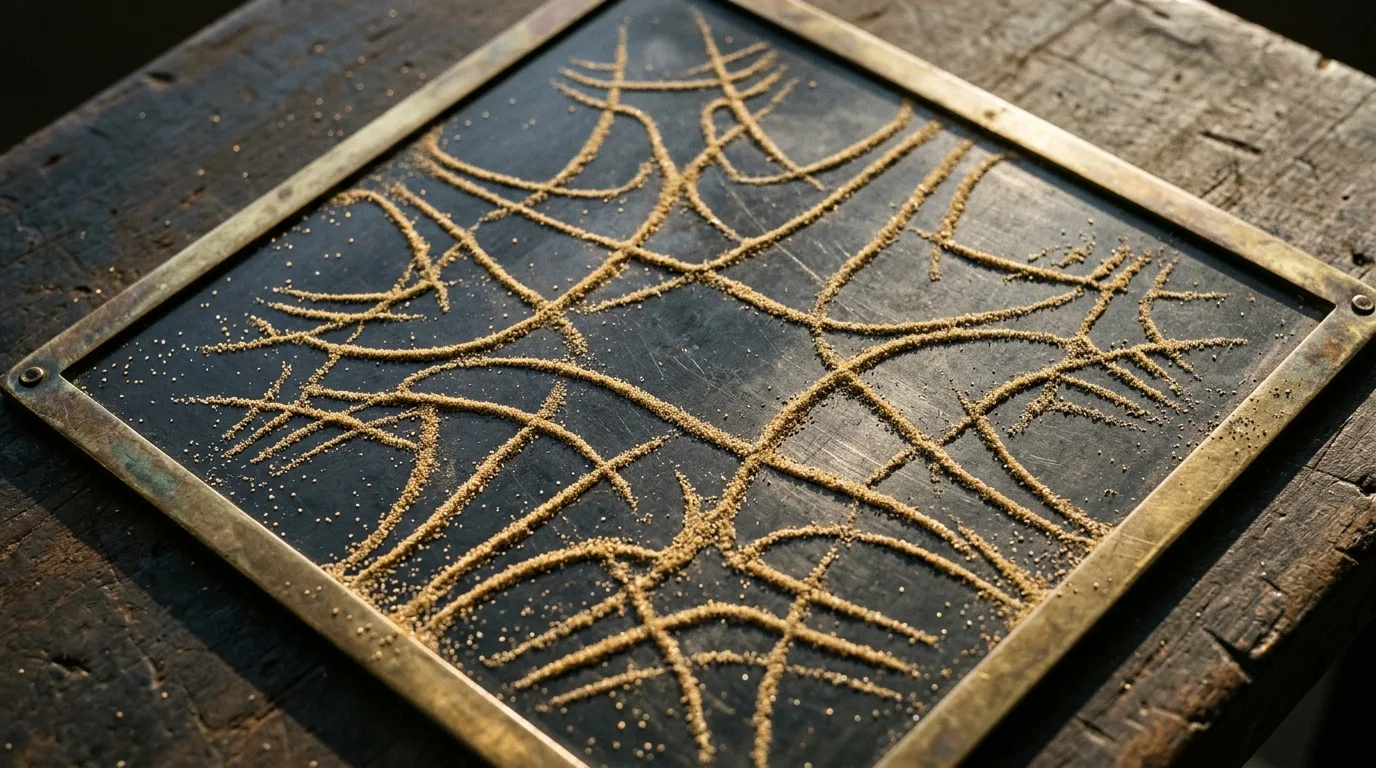
In 1787 a German physicist and musician named Ernst Chladni published diagrams of sound that could be seen. The Public Domain Review describes them as drawings from his book Entdeckungen über die Theorie des Klanges, the work that introduced his vibrating-plate experiments systematically. The method was simple: sand, a metal plate and a violin bow.
A free simulation from x9m8, a site run by the same owner as Marcellino NY, lets the pattern form on screen. Pick two numbers, and the grains find the quiet lines.
The tool has a full screen button and lives at apps.x9m8.com/chladni-plates.
Hooke first, Chladni second
Robert Hooke got there a century earlier. APS News dates his experiment to July 8, 1680: he ran a violin bow along the edge of a plate and watched the powder arrange itself. Sources differ on the material, with the APS describing sand on metal and The Public Domain Review describing flour on glass.
Chladni made it systematic. According to the Whipple Museum, his plates were stroked with a violin bow until they resonated at a natural frequency, and the sand then bounced about until it settled at the still points.

Why the sand goes where it goes
A bowed plate splits into regions that move in opposite directions. The boundaries between them do not move at all. The Irish Times explains that grains bounce away from the strongly oscillating parts and gather where the vibration is least. Those quiet curves are called nodal lines.
Finer dust behaves the other way. APS News notes that very fine particles shed by Chladni’s bow migrated toward the antinodes, the places of strongest motion.
Napoleon and the prize
The figures reached Paris in 1808. The Irish Times reports that Chladni demonstrated the plates at the Academy of Science and that Napoleon, in attendance, proposed a prize for a mathematical explanation. The Matemateca of the University of São Paulo puts the prize at 3,000 francs and says it went to Sophie Germain, who modeled plate vibration with a fourth-order partial differential equation. Gustav Kirchhoff later gave a more accurate treatment of the boundary conditions.

The Irish Times adds that Germain became the first woman to win the Paris Academy’s Grand Prize in Mathematics, in 1816.
A tool for violin makers
The figures were not only a parlor show. The Smithsonian notes that violin makers have long used Chladni figures for feedback while shaping the front and back plates of an instrument. The Whipple Museum adds that Chladni spent many years touring Europe giving performances.
What the simulation shows
- Pick n and m with two sliders. The pattern is the set of points where cos(nπx)cos(mπy) − cos(mπx)cos(nπy) equals zero.
- About 42,000 grains jitter in proportion to how much the plate moves under them, so they pile up on the quiet lines, as on a real plate.
- Amber and blue glow shows the two halves of the plate moving in opposite directions.
- A sound toggle plays a pitch for each mode. The pitch is an illustrative scale, since real plates have their own mode frequencies.
The formula describes an idealized square plate. Real plates follow the fourth-order theory Germain started and Kirchhoff refined, so the simulation is a picture of the idea and not a measurement.

Sources
- APS News, first experiments behind Chladni figures
- The Public Domain Review, Chladni Figures (1787)
- Whipple Museum, Ernst Chladni
- Whipple Museum, acoustical work
- The Irish Times, Sophie Germain
- Matemateca, Chladni plates
- Smithsonian, Chladni plates


