
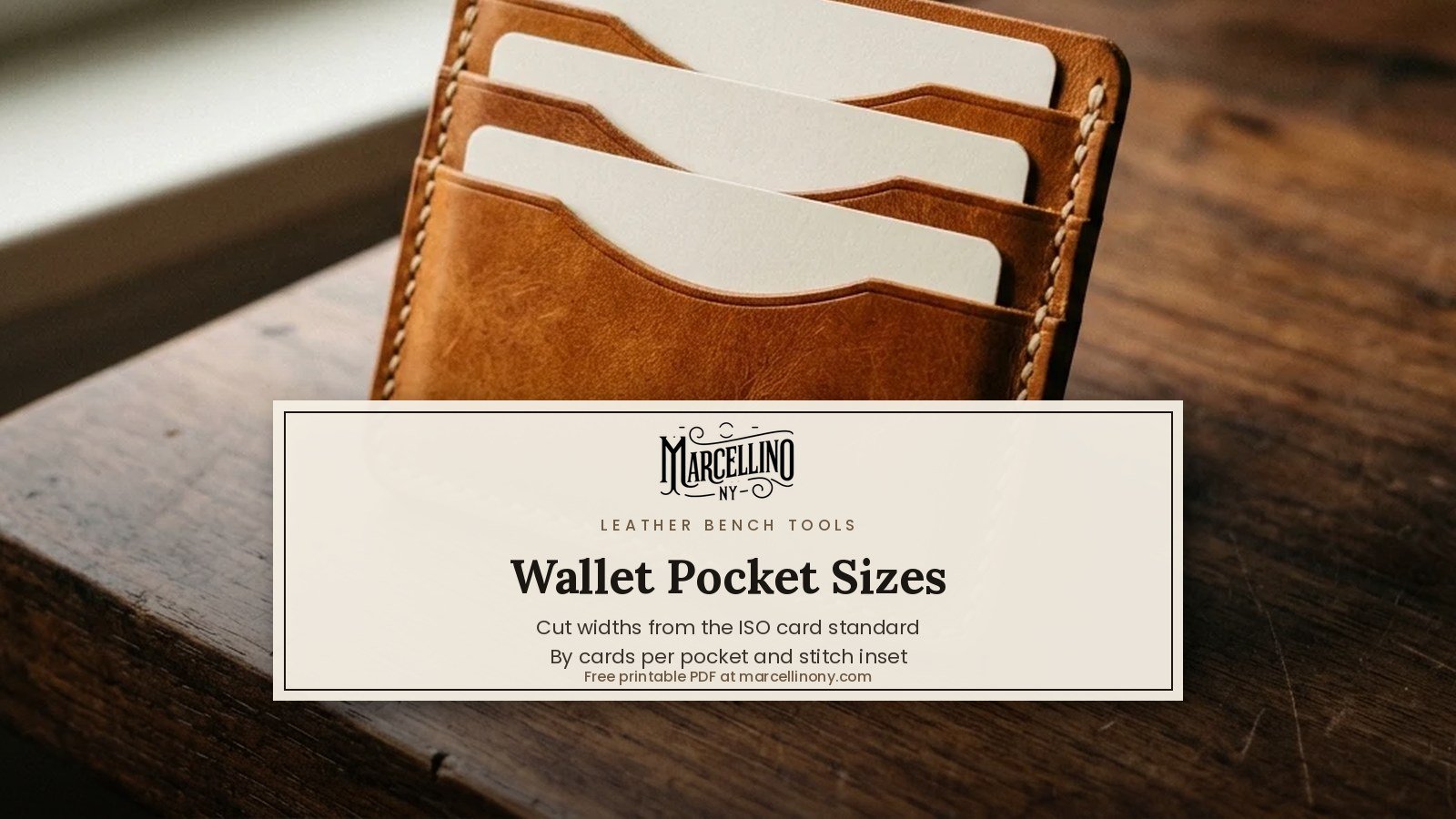
Every credit card, debit card, driver’s licence and gym pass in a wallet is the same rectangle: 85.60 by 53.98 millimetres, with a nominal thickness of 0.76 mm. That is the ID-1 size in the international standard for identification cards, ISO/IEC 7810, and it is the one number a wallet maker can count on. Everything else, the leather, the stitching and how many cards the owner jams into one slot, moves.
Marcellino NY Bench Tool No. 8
Wallet Pocket Sizes: Free Printable PDF
⬇ DOWNLOAD THE BENCH TOOL (PDF)2 pages · US Letter, print at 100% · card and banknote sizes, pocket width chart by cards and inset, true-size outlines
The free Marcellino NY Bench Tool No. 8: Wallet Pocket Sizes starts from that rectangle and works outward. It gives a cut width for a horizontal card pocket by the number of cards it should hold and the distance of the stitching from its edge, and prints a card and a US banknote at true size for checking pieces before they are cut.
The fixed sizes
Four items set the size of almost every wallet.
| Item | Size | Source |
|---|---|---|
| Payment or ID card (ID-1) | 85.60 × 53.98 mm, 0.76 mm thick | ISO/IEC 7810 |
| ID-2 card | 105 × 74 mm | ISO/IEC 7810 |
| Passport booklet (ID-3) | 125 × 88 mm | ISO/IEC 7810 |
| US banknote | 6.14 × 2.61 in (156 × 66.3 mm) | uscurrency.gov |
A uscurrency.gov history sheet for the $10 note records 1929 as the year its size was reduced to 6.14 by 2.61 inches, the size of US paper money in wallets today. Folded once, it is 3.07 by 2.61 inches, which is why a bifold’s bill pocket has to open to at least 6.14 inches end to end and stand at least 2.61 inches tall. The ISO catalogue page marks the 2003 edition of the card standard as withdrawn and revised in 2019; the ID-1 rectangle is the same one in everyday use.
How much each card adds
A card pocket is a face of leather stitched to a back along both short sides. Empty, the face lies flat. Full, it has to climb up over the stack at one stitched edge, run across, and come down at the other. So every card in the pocket takes width as well as thickness: about twice its own 0.76 mm, or roughly 1.5 mm per card.
That gives the chart’s formula:
Pocket cut width = 85.6 + 2 × (cards × 0.76) + 2 × stitch inset + clearance
with a 2 mm clearance so the card slides instead of wedging. The chart runs it for one to six cards and three stitch insets, 3/32, 1/8 and 5/32 inch.
| Cards | Inset 2.4 mm (3/32 in) | Inset 3.2 mm (1/8 in) |
|---|---|---|
| 1 | 93.9 mm (3.70 in) | 95.5 mm (3.76 in) |
| 2 | 95.4 mm (3.76 in) | 97.0 mm (3.82 in) |
| 3 | 97.0 mm (3.82 in) | 98.6 mm (3.88 in) |
| 4 | 98.5 mm (3.88 in) | 100.1 mm (3.94 in) |
| 6 | 101.5 mm (4.00 in) | 103.1 mm (4.06 in) |
Six cards against one is 7.6 mm of extra width at the same inset, about the thickness of a pencil. A pocket cut for one card and stuffed with six will not bulge politely. It will pull at the stitches until something gives.

What makers do
Two experienced makers on leatherworker.net give rules that land close to the chart. On a thread about wallet card slots, NVLeatherWorx writes: “I always cut my pockets between 1/2″ and 5/8″ wider than the card width,” prefers two cards per pocket, and stitches 3/32 to 1/8 inch from each edge. That is 12.7 to 15.9 mm over the card. The chart gives 9.8 to 11.4 mm for two cards at the same insets, so his rule carries a few millimetres more ease, about what the chart gives for three or four cards.
On a thread about wallet sizes, JLSleather puts it as a rule: “you have to make the pocket for something the size of the item plus the thickness of the leather.” His method is physical. Crease the leather over the card, measure between the creases, then add about a quarter inch per side.
Both methods come out near half an inch over the card’s width. The chart explains the half inch instead of inheriting it, and shows how it should shrink for a single-card slot or grow for a slot that is going to carry five.
Room to stretch
Leather stretches, and the same thread says so. MarkCdub writes that “you don’t want to make the card slots too much wider than the cards,” because the leather gives as the wallet is used, and tests his slots with old credit card offers before committing. Another member keeps a stack of expired cards and old IDs for exactly that test.
That is the counterweight to the chart. The formula sizes a pocket that holds its cards on day one. Vegetable-tanned leather worn in a back pocket for a year will not be the same pocket. A slot that grips a new card firmly has room to loosen into a comfortable one. A slot that is easy on day one has nowhere to go but looser. Makers who cut on the tight side are betting on the stretch.
The chart’s 2 mm clearance is a middle setting. Cut to the chart with the clearance removed for a snug, break-in pocket in firm leather, or leave it in for thin, soft leather that will not stretch much more. Then push an old card in and pull it out a few times before the pocket is stitched, with the face held where the stitches will go.

Height, stacking and the bill pocket
Card height is 53.98 mm, and a pocket deeper than that hides the card completely. Most wallets stack several pockets in tiers, each set lower than the one behind it so the top edge of every card shows. The chart lists a visible step of 12 to 16 mm as a common choice and a lowest pocket depth of roughly the card height minus 10 mm, so there is something to pinch. Those are layout conventions, not standards, and every pattern in the Marcellino NY series sets its own.
Stacking adds thickness at the stitch line, which is where MakeSupply’s bifold tips recommend T-shaped slots, because they keep the edge thickness uniform however many slots there are. The same tips keep the inner shell and card pockets in the 2 to 3 oz range.
The bill pocket runs the width of an open bifold. The Marcellino NY bifold wallet pattern uses a 9.25 by 3.5 inch outer, which clears a 6.14 by 2.61 inch note with room for the stitch line and the fold. A slim card holder skips the bills entirely and is sized from the card alone.
Vertical slots and the passport
Turn the card on its end and the same arithmetic applies to the short side. A vertical slot, the kind found on minimalist card holders where cards drop in from the top, needs 53.98 mm plus the same allowances. At a 1/8 inch inset and 2 mm clearance, that is 63.9 mm for one card, 65.4 mm for two and 66.9 mm for three. A vertical slot is narrower but deeper, and the stack sits across the narrow dimension, so each card is a larger share of the width: six cards add 9 mm to a 54 mm card, about 17 percent, against 11 percent on a horizontal pocket.
The ID-2 card, the middle size in the standard at 105 by 74 mm, is rarer in a wallet, but anything carried in that format gets the same arithmetic with 105 in place of 85.6: a two-card pocket at a 1/8 inch inset cuts to 116.4 mm.
The passport is the other fixed size. The ID-3 booklet in ISO/IEC 7810 is 125 by 88 mm, which sets the inside of a passport cover the same way the card sets a wallet pocket. A passport is a booklet, far thicker than a card, and booklets differ from one country and one owner to the next. The pocket that takes the cover board is the one place on the bench where the chart steps aside: slide the real passport in before the pocket is stitched, close the cover around it, and adjust.

The true-size page
Page 2 of the PDF prints an ID-1 card outline, the cut width of a two-card pocket beside it as a dashed rectangle, and a US banknote with its fold line, all at true size. Print at 100 percent and check the scale square first.
Lay the leather pieces on the outlines before cutting. If the pocket face does not cover the dashed rectangle, it will not hold two cards. If the outer shell does not clear the folded note, the wallet carries no cash.
Marcellino NY Bench Tool No. 8
Wallet Pocket Sizes: Free Printable PDF
⬇ DOWNLOAD THE BENCH TOOL (PDF)2 pages · US Letter, print at 100% · card and banknote sizes, pocket width chart by cards and inset, true-size outlines
Sources
- ISO/IEC 7810:2003 catalogue page, identification cards, physical characteristics: https://www.iso.org/standard/31432.html
- uscurrency.gov, $10 note features 1914-1990 (size reduction to 6.14 x 2.61 in): https://www.uscurrency.gov/sites/default/files/downloadable-materials/files/en/10-1914-1990-features-en.pdf
- Wallet card slots, leatherworker.net: https://leatherworker.net/forum/topic/59006-wallet-card-slots
- Wallet sizes, leatherworker.net: https://leatherworker.net/forum/topic/86396-wallet-sizes
- MakeSupply, 4 tips for making a bi-fold wallet: https://projects.makesupply.co/leathercraft-tutorials/4-tips-for-making-a-bi-fold-wallet/
- Video: Marcellino NY Briefcase Maker on YouTube, https://www.youtube.com/watch?v=B24Ei5Zv_WQ
You might also like
- Slim Card Holder Pattern and Build Steps
- Leather Bifold Wallet Pattern: Four Pockets for Cards and Bills
- A Card Wallet With One Seam
- Leather Business Card Case Pattern with Flap and Snap


