
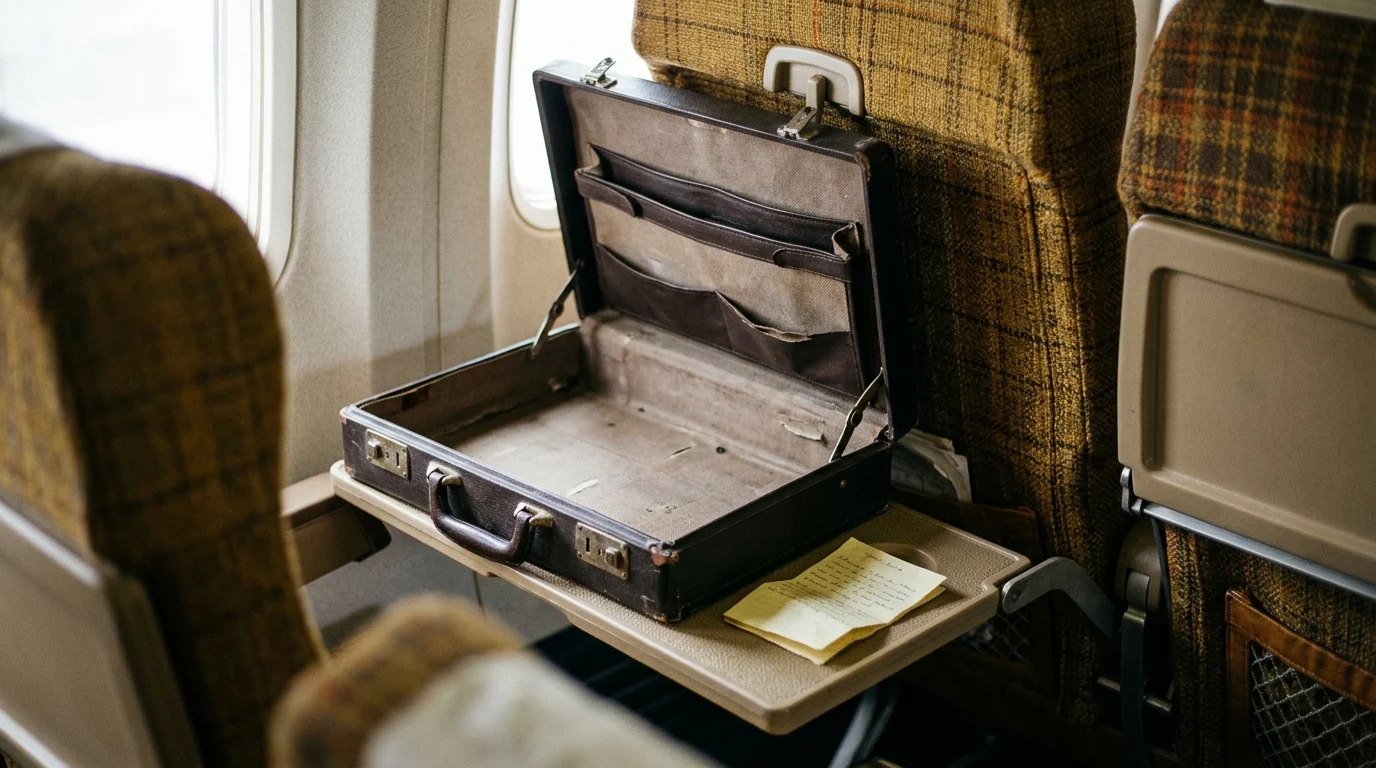
The most famous briefcase in American crime history was cheap. That is the FBI’s word for it, not a critic’s. On the afternoon of November 24, 1971, a man calling himself Dan Cooper, who had paid cash for a one-way ticket on Northwest Orient Flight 305 out of Portland bound for Seattle, handed a stewardess a note saying he had a bomb, and then, in the Bureau’s telling, did this: “Opening a cheap attaché case, Cooper showed her a glimpse of a mass of wires and red colored sticks.”
Next Tuesday marks 55 years. The FBI still calls the hijacking one of the great unsolved mysteries in FBI history, and the attaché case has never been the part anyone argues about. The demand Cooper made of the airline, though, raises a physical question the case itself never answered, and a calculator can settle it: would the money he asked for have fit in a bag like the one he carried?
The Demand, in the FBI’s Words
Four parachutes and a very specific denomination
The FBI’s history page sets out the terms. Cooper demanded four parachutes and $200,000 in twenty-dollar bills. The 2006 FBI story on the anniversary records that the hijacker exchanged the flight’s 36 passengers for the money and parachutes.

How the cash travelled matters for everything below. The FBI’s account does not put it in the attaché case. It describes a bag: Cooper used the cord from one of the remaining parachutes to tie the stolen money bag shut, and he jumped with two parachutes, one of them an instruction chute that had been sewn shut.
So the briefcase here is a thought experiment. As far as the FBI’s account goes, Cooper never tried to pack $200,000 into his attaché, and the case he did open was already occupied by what he claimed was a bomb. Who he was sits outside the arithmetic entirely; the FBI’s own pages stop at what the evidence shows, and the figures below stop there too.
Some money did come back. In 1980, according to the FBI, a young boy found a rotting package full of twenty-dollar bills ($5,800 in all) that matched the ransom serial numbers. In July 2016, the Bureau redirected the resources it had assigned to the case to other investigative priorities.
Three Numbers From the Currency Agencies
Size, weight and a stack a mile high
Two hundred thousand dollars in twenties is 10,000 notes. That part needs no source. Everything else does, so the inputs below come from the Bureau of Engraving and Printing and the U.S. Currency Education Program, which the Federal Reserve Board manages, not from trivia sites.
- Size. The Bureau of Engraving and Printing’s history fact sheet on Federal Reserve notes says the old large-size notes were reduced to their present size (6.14 x 2.61 inches).
- Weight. The BEP’s currency FAQ gives the approximate weight of a note, regardless of denomination, as one gram. The currency education site U.S. Currency adds that because a pound holds 454 grams, there are 454 notes in one pound of currency.
- Thickness. Neither agency, on the pages fetched for this post, prints a thickness. U.S. Currency does say that a stack of currency one mile high would contain more than 14.5 million banknotes. A mile is 63,360 inches, and 63,360 divided by 14.5 million gives 0.00437 inches per note.
The phrase “more than” makes that last figure a ceiling. If a mile-high stack holds more than 14.5 million notes, each note is a hair under 0.00437 inches. Every capacity figure below therefore leans slightly against the briefcase; how slightly, the agencies’ wording doesn’t say.
The paper, for the record, is not paper in the stationery sense. The BEP says currency paper is composed of 75 percent cotton and 25 percent linen, which puts it closer to a shirt collar than to a legal pad.
The Arithmetic
Twenty-two pounds and a 43-inch stack
Run through a short Python script, the inputs produce this:

| Quantity | Input or formula | Result | |—|—|—| | Notes | $200,000 ÷ $20 | 10,000 | | Footprint of one note | 6.14 in × 2.61 in | 16.03 sq in | | Thickness per note (upper bound) | 63,360 in ÷ 14,500,000 | 0.00437 in (0.111 mm) | | Volume of all notes, packed tight | 10,000 × 16.03 × 0.00437 | 700 cubic inches (11.5 liters) | | Height if stacked in one column | 10,000 × 0.00437 | 43.7 in (3.6 ft) | | Weight | 10,000 × 1 g | 10 kg, or 22.0 lb at 454 notes per pound |
Seven hundred cubic inches is the floor, the volume of perfectly flat new notes with no rubber bands, no straps, no air. Real money that has been through wallets is not that cooperative, though no figure for how much it swells was found in the sources here, so the model leaves that out rather than guess.
Twenty-two pounds is the number that changes the picture. Hung from a single handle at the end of one arm, that much paper stops behaving like a document case and starts behaving like luggage.
Testing It Against Real Cases
An aluminum attaché, a leather one, and the textbook size
Volume alone is not the whole answer, because notes are rectangles and briefcase floors are rectangles of different proportions. The script tried every guillotine-style layout of 6.14 × 2.61 inch footprints on each floor, picked the one that fit the most stacks, and then counted how many notes each stack could hold at the case’s depth.
The modern hard attaché. Zero Halliburton lists interior dimensions for its ZH Pursuit Aluminum Medium Attaché Case as 17.1 x 2.8 x 12.2 inches, with a weight of 5.6 pounds. That interior is 584 cubic inches, already smaller than 700. The best layout puts ten stacks on the floor, and at 2.8 inches of depth each one takes 640 notes before the lid starts to argue.
Ten stacks of 640 is 6,400 notes, or $128,000. The other $72,000 stays on the tarmac.
The textbook attaché. Sven Raphael Schneider of Gentleman’s Gazette, writing about the form, says most attaché cases run about 18 by 12 by 3 or 4 inches, sized to an A3 sheet. Those are general figures, closer to outside dimensions than to a measured interior, which flatters the case. Even so:
- At 18 × 12 × 3 inches: ten stacks of 686 notes, 6,860 notes, $137,200.
- At 18 × 12 × 4 inches: ten stacks of 915 notes, 9,150 notes, $183,000.
The four-inch version comes within 850 notes. It still loses. To hold ten stacks of 1,000 on a floor that size, a case needs about 4.37 inches of clear interior depth, or notes thinner than 0.004 inches, which the mile-high figure doesn’t support.
The leather attaché. Ettinger lists its Heritage St James Lid-Over Attaché Case, in Buttero leather with a suede interior, at 40.9 x 8.9 x 28.9 cm closed, a net weight of 2,500 grams, and a price of £4,060. Converted, that is about 16.1 × 3.5 × 11.4 inches, or 642 cubic inches on the outside, against a ransom that needs 700 with no walls, no frame and no lining. The case could be hollowed to the stitching and it still would not close.
| Case | Space used for the test | Notes that fit | Dollar value | Fits $200,000? | |—|—|—|—|—| | ZH Pursuit Medium Attaché | 17.1 × 12.2 × 2.8 in interior | 6,400 | $128,000 | No | | Attaché at 18 × 12 × 3 in | general size, not interior | 6,860 | $137,200 | No | | Attaché at 18 × 12 × 4 in | general size, not interior | 9,150 | $183,000 | No | | Ettinger St James | 642 cu in exterior | under 10,000 by volume alone | — | No |
(All figures calculated by this publication from the sources linked above. The thickness value is an upper bound derived from U.S. Currency’s mile-high stack, so real capacities may run slightly higher.)
The Case for the Briefcase
What the numbers leave out
Every figure above leans against the case in one way. The thickness is a ceiling, and a determined packer would not stop at neat stacks. Loose notes stuffed into the strips along the walls could close part of the gap in the four-inch case. A soft-sided briefcase on an 18-by-12-inch floor, with a three-inch gusset that bulges to five, would swallow the whole sum: ten stacks of 1,144 notes. The question was framed around a structured case, the kind with a frame that keeps its shape, and the frame is exactly what costs the capacity.

In another way the figures flatter it, because no case in the table is the case Cooper carried. The FBI calls his cheap and gives no dimensions for it, and whatever it held, it was already holding the device he showed the stewardess. A man who has filled his attaché with wires and red sticks has, as a matter of packing, run out of attaché.
The attaché form itself argues against the job. Schneider describes it as a simple box designed to hold an A3 sheet of paper, its leather stretched over a rigid wooden or steel frame, and traces the name to the junior diplomatic post of attaché. It is built for flat things that should arrive flat. Ten thousand banknotes are flat things too, but 22 pounds of them turn a document case into a strongbox hanging from a handle designed with papers in mind.
Why the Bag Made Sense
The ransom went where volume was free
On the FBI’s account, the money came aboard in a bag, and Cooper tied it shut with parachute cord. A bag has no frame, no fixed depth and no walls that refuse to give. For moving 700 cubic inches of paper, that is the correct tool, which is a strange compliment to pay a hijacker’s packing.
A briefcase maker’s honest note belongs here. Marcellino NY makes and sells bridle leather briefcases, and the framed, structured case this post has been measuring is the kind of object the workshop believes in. The table is still the table. Structure is a trade: shape, protection and a case that stands up on a desk, paid for in cubic inches.
In 1980 a boy found $5,800 of the twenties in a rotting package, matched to the ransom by serial number. The FBI’s pages record no other recovery. The other $194,200, by the same arithmetic, would take up roughly 680 cubic inches, still more than the aluminum attaché can hold with its lid shut.
You Might Also Like
- Will a 16-Inch Laptop Fit in a Leather Briefcase?
- Bolt Heads on a Lock Plate: Why the Lock Goes Through the Flap
- Inspecting a Used or Vintage Leather Briefcase Before Buying
Sources
- FBI, “A Byte Out of History: The D.B. Cooper Mystery,” November 24, 2006: https://www.fbi.gov/news/stories/2006/november/dbcooper_112406
- FBI, “D.B. Cooper Hijacking,” Famous Cases and Criminals: https://www.fbi.gov/history/famous-cases/db-cooper-hijacking
- Bureau of Engraving and Printing, “BEP History Fact Sheet: Federal Reserve Notes” (updated April 2013): https://www.bep.gov/media/1081/download
- Bureau of Engraving and Printing, Currency FAQs: https://www.bep.gov/currency/faqs
- U.S. Currency Education Program, “Currency Facts”: https://www.uscurrency.gov/about-us/currency-facts
- U.S. Currency Education Program, “About Us”: https://www.uscurrency.gov/about-us
- Zero Halliburton, ZH Pursuit Aluminum Medium Attaché Case product page: https://www.zerohalliburton.com/products/pursuit-aluminum-medium-attache-case
- Sven Raphael Schneider, “Why an Attaché Case Beats Briefcases & Men’s Messenger Bags,” Gentleman’s Gazette, January 20, 2022: https://www.gentlemansgazette.com/attache-case-guide/
- Ettinger, Heritage St James Lid-Over Attaché Case product page: https://ettingerlondon.com/products/heritage-st-james-lid-over-attache-case
For informational purposes only — consult a licensed attorney or financial advisor.


