
On June 30, 1975, Business Week ran a cover package called “The Office of the Future”, issue 2387, pages 48 to 70, which Wikipedia lists as an early prediction of the paperless office. One of the people it quoted was George E. Pake, head of Xerox’s Palo Alto Research Center, who expected a TV-display terminal with a keyboard on his desk by 1995 and said, as Business Insider later quoted the article, “I don’t know how much hard copy I’ll want in this world.”
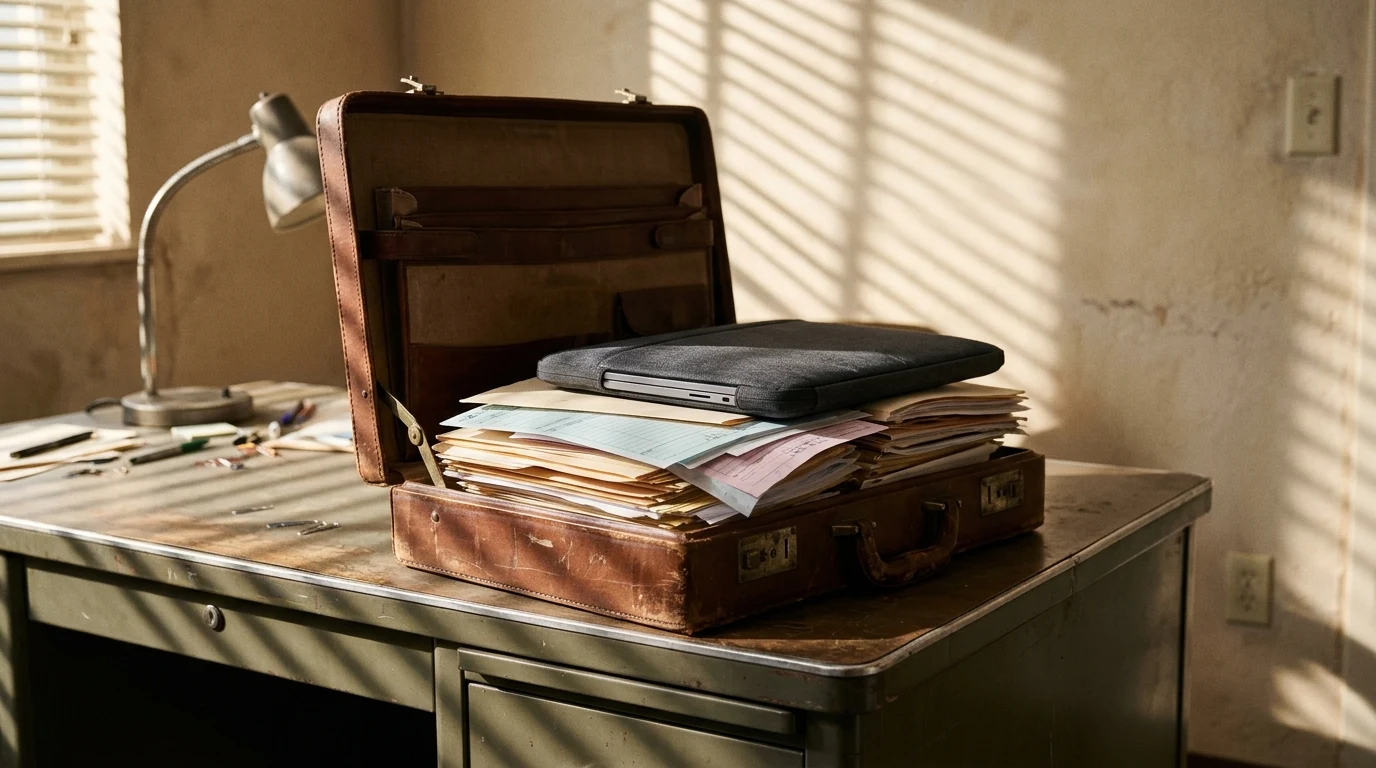
Pake got the terminal. The hard copy kept coming for another quarter century, and the bag that was built to haul it found a second job before the paper ever left.
IBM Was Selling the Cure Before the Disease Peaked
A Selectric, a tape drive and a Jim Henson film
The fear of drowning in paper is older than the personal computer. In 1964 IBM introduced the Magnetic Tape/Selectric Typewriter, or MT/ST, a machine on which, according to HistoryofInformation.com, typed material could be edited without retyping the whole text. IBM marketed it as a “word processing” machine, the first use of the term in that sense, by the same account.

Jim Henson got the job of selling it. IBM hired him to make a short film promoting the machine, and Paperwork Explosion, produced in October 1967 with an electronic soundtrack by Raymond Scott, is a quick-cut montage of images and words. Gizmodo called it a “jarring brew of jargon and flashing images”. Underneath the strobe, the message was simple: one machine could help control the flood of documents a business office produced.
By 1975 the sales film had grown into a forecast. Pake’s prediction put a screen and keyboard on the executive desk, and his line about hard copy carried the idea that printed paper might become optional. Nobody in that article, as far as the quoted excerpts show, said the briefcase was finished. The logic did the talking: if documents lived on screens, a leather box built to carry documents had no reason to exist.
That same year Charlie Clifford started a luggage company. Wikipedia, citing Fortune, records that Tumi was founded in 1975, and the brand became known for black-on-black ballistic nylon bags. A forecast that documents would move to screens and a new maker of business bags arrived in the same year, one predicting the end of the cargo and the other building containers for it.
The Numbers Went the Wrong Way for Twenty Years
What the EPA counted, and what it counted with it
The Environmental Protection Agency tracks paper and paperboard in municipal solid waste, the stuff Americans throw out or recycle. Its material-specific data page lists generation for selected years, in thousands of tons:
| Year | Paper and paperboard generated (thousand tons) | |—|—| | 1980 | 55,160 | | 1990 | 72,730 | | 2000 | 87,740 | | 2005 | 84,840 | | 2010 | 71,310 | | 2015 | 68,050 | | 2018 | 67,390 |
Run the percentages and the shape is a hill:
- 1980 to 2000: up 59.1 percent.
- 2000 to 2010: down 18.7 percent.
- 2000 to 2018: down 23.2 percent.
- 1980 to 2018: still up 22.2 percent.
(Calculations from the EPA figures above.)
From 1980 to 2000, the two decades in which the personal computer went from hobby kit to office standard, paper and paperboard generation rose 59.1 percent. After 2000 it fell 23.2 percent by 2018. Even at the end of that slide, Americans were generating 22.2 percent more paper and paperboard than in 1980. The 2000 figure is the highest among the years the EPA lists, though the page shows only selected years, so a true annual peak could sit a year or two to either side.
There is a catch in the data, and it is a large one. The EPA category covers office papers, newspapers, tissue and paper plates and cups, and it also covers containers and packaging: corrugated boxes, milk cartons, bags and sacks. A spreadsheet printout and a shipping carton land in the same column. The hill in the table is not a clean measure of the paper that rode to work in a briefcase, and nothing on the EPA page separates office paper out by tonnage.
Other measurements point the same way, though. Wikipedia cites one estimate that worldwide use of office paper more than doubled from 1980 to 2000. And the researchers Abigail Sellen and Richard Harper, in The Myth of the Paperless Office (MIT Press, 2002), reported a finding that reads like a punchline. According to the book’s abstract on Microsoft Research, “The use of e-mail in an organization causes an average 40 percent increase in paper consumption.”
Why Screens Made More Paper
The printer sat next to the terminal
The Sellen and Harper argument was never that paper beats screens; it was that new tools change what paper is for. Writing about their book in American Heritage in 2002, Frederick E. Allen summarized their research as finding that new technologies “will usually shift the role of paper rather than replace it”. Allen’s own example was the meeting: a paper document can be passed around and annotated while the discussion goes on, which a screen of that era did badly.

Microsoft Research’s abstract makes the point about the web directly: a system that let almost any computer display another computer’s documents also increased the amount of printing done. Every new screen was another place for a document to start life, and the printer down the hall finished the job.
So through the 1980s and 1990s there was more paper in the office to carry home, not less. The story could have stopped there, with the forecast wrong and the bag safe, except that a second object was getting small enough to ride along.
The Computer Climbs Into the Bag
From a 24.5-pound suitcase to a sleeve
The Osborne 1 was introduced in April 1981 at $1,795. Carleton University’s vintage computing collection describes it as a suitcase-style design weighing 24.5 pounds, with a five-inch monochrome screen and a keyboard that latched onto the case. It could fit under an airplane seat. It was its own luggage; no briefcase was involved.
Within a generation the machine shrank to something a briefcase could swallow, and the bag trade rebuilt itself around that fact. A McClatchy Newspapers report published in The Vindicator in January 2008 described a working world in which “the square, hard-body briefcase collects dust in the closet,” pushed aside by the shoulder-hanging laptop bag, and passed along the view that a briefcase couldn’t protect a laptop the way a padded laptop bag could. Lisa Wells, a spokeswoman for Tumi, told the paper that briefcases were still about 60 percent of the company’s business; the same story noted that over the previous five years the Tumi line had grown to include messenger and laptop bags.
Ellen Goldstein, chair of the accessories design department at the Fashion Institute of Technology, told the same reporter that the biggest update to the case since James Bond popularized the attaché was a convertible shoulder strap, added a few years earlier. Forty years of office revolution, and the headline change to the form was a strap.
The real redesign happened inside the bag. By 2024 a Sacramento clothier, Ryan Douglas Hammonds of R. Douglas Custom Clothier, was describing the modern load to Comstock’s magazine in terms of a thin MacBook Air that men simply put in a sleeve. “We’re carrying less and less papers, less and less binders,” he said. The padded compartment that once would have held a stack of manila folders now holds one flat, expensive slab of aluminum.
When Washington Wrote a Spec for the Laptop Compartment
Butterfly, trifold, sleeve
One of the plainest records of how the inside of a business bag changed was written by the federal government. In August 2008 the Transportation Security Administration announced that, starting August 16, travelers with “checkpoint friendly” laptop bags could leave the computer inside the bag at airport screening. Occupational Health & Safety, reporting the announcement on August 6, 2008, listed the standards a bag had to meet:

- a designated laptop-only section
- that section completely unfolds to lay flat on the X-ray belt
- no metal snaps, zippers or buckles inside, underneath or on top of it
- no pockets on the inside or outside of it
- nothing packed in it other than the computer itself
The Christian Science Monitor reported that the accepted styles were butterfly, tri-fold and sleeve, while accordion bags and backpacks still required the laptop to come out. Owning one guaranteed nothing; the paper quoted a TSA press release warning that buying such a bag “will not guarantee that you can leave your laptop in your bag for screening.” TSA Administrator Kip Hawley, according to Occupational Health & Safety, said bag manufacturers had answered the agency’s challenge with products that offered “a win-win for travelers and TSA.”
The square, hard-body case of the Vindicator story was built around open space. The TSA spec described something closer to a holster: one object, one compartment, nothing metal near it, opening flat like a book. A government checklist was now telling bag makers what the inside of a work bag should look like, and they built to it.
The Case That the Laptop Saved the Bag, Not the Briefcase
Backpacks took the same cargo
The tidy version of this story says the briefcase survived the paperless office by switching cargo. The evidence supports a weaker claim. The laptop kept a bag in the professional’s hand. It did not guarantee that bag would be a briefcase.
In a column summarized in January 2009 by The Week, the Financial Times writer Rhymer Rigby argued that the briefcase was heading the way of the bowler hat, pushed out by pocket-sized technology and relaxed dress codes. He was not kind to the alternatives either. Backpacks, he wrote, “make you look very, very junior.”
The backpacks won anyway. Comstock’s in 2024 reported that The Wall Street Journal declared the briefcase dead in 2007, and pictured the commuters climbing out of a New York City subway station as one long run of backpacks. James Lileks, writing in the Star Tribune in October 2023, said briefcases had vanished from the culture and that backpacks had replaced them, more practical but lacking structure. He noted, in passing, that product reviews showed truckers liked briefcases as a place to keep their logs.
Paper, by the EPA’s count, was still above its 1980 level in 2018. The computer that was supposed to replace it needed a bag of its own, and for a great many commuters the answer turned out to be a nylon sack worn on both shoulders.
The TSA’s rule for the laptop compartment ran to five lines. The last one read: nothing packed in it other than the computer itself.
Products Mentioned
The Myth of the Paperless Office The 2002 MIT Press study of why offices kept printing after email and the web arrived. See it on Amazon (affiliate link)
As an Amazon Associate I earn from qualifying purchases. A commission may be earned if you buy through this link, at no extra cost to you.
You Might Also Like
- Will a 16-Inch Laptop Fit in a Leather Briefcase?
- Inspecting a Used or Vintage Leather Briefcase Before Buying
- Bolt Heads on a Lock Plate: Why the Lock Goes Through the Flap
Sources
- “Paperless office,” Wikipedia (citation for “The Office of the Future,” Business Week no. 2387, pp. 48–70, June 30, 1975; office paper estimate): https://en.wikipedia.org/wiki/Paperless_office
- “40 Years Ago, This Is What People Thought The Office Of The Future Would Look Like,” Business Insider India (quoting the June 30, 1975 Business Week article): https://www.businessinsider.in/40-years-ago-this-is-what-people-thought-the-office-of-the-future-would-look-like/articleshow/45363770.cms
- “IBM’s MT/ST Begins ‘Word Processing’ to Help with the Paperwork Explosion,” HistoryofInformation.com: https://historyofinformation.com/detail.php?id=819
- Gizmodo, on Jim Henson’s 1967 IBM film The Paperwork Explosion: https://gizmodo.com/watch-the-paperwork-explosion-jim-hensons-weirdly-si-5811172
- “Tumi Inc.,” Wikipedia (citing Fortune and Business Week): https://en.wikipedia.org/wiki/Tumi_Inc.
- U.S. EPA, “Paper and Paperboard: Material-Specific Data”: https://www.epa.gov/facts-and-figures-about-materials-waste-and-recycling/paper-and-paperboard-material-specific-data
- Abigail J. Sellen and Richard H. R. Harper, The Myth of the Paperless Office, abstract, Microsoft Research: https://www.microsoft.com/en-us/research/publication/myth-paperless-office/
- Frederick E. Allen, “The Myth of the Paperless Office,” American Heritage, November/December 2002: https://americanheritage.com/myth-paperless-office
- Osborne 1, Carleton University School of Computer Science vintage computing collection: https://carleton.ca/scs/vintage-computing/item/vin18/
- “Casual bag replaces traditional briefcase,” McClatchy Newspapers via The Vindicator, January 2, 2008: https://vindyarchives.com/news/2008/jan/02/casual-bag-replaces-traditional-briefcase
- Judy Farah, “Death of a Briefcase,” Comstock’s, July 31, 2024: https://comstocksmag.com/article/death-briefcase
- “TSA to Allow ‘Checkpoint Friendly’ Laptop Bags,” Occupational Health & Safety, August 6, 2008: https://ohsonline.com/articles/2008/08/tsa-to-allow-checkpoint-friendly-laptop-bags.aspx
- “TSA laptop policy change good news for convention-bound,” Christian Science Monitor: https://m.csmonitor.com/USA/Politics/The-Vote/2008/0816/tsa-laptop-policy-change-good-news-for-convention-bound
- “Business columns: The death of the briefcase,” The Week (summarizing Rhymer Rigby, Financial Times), January 16, 2009: https://theweek.com/articles/509338/business-columns-death-briefcase
- James Lileks, “The once prestigious briefcase has lost out to backpacks,” Star Tribune, October 26, 2023: https://www.startribune.com/the-once-prestigious-briefcase-has-lost-out-to-backpacks/600314916


