
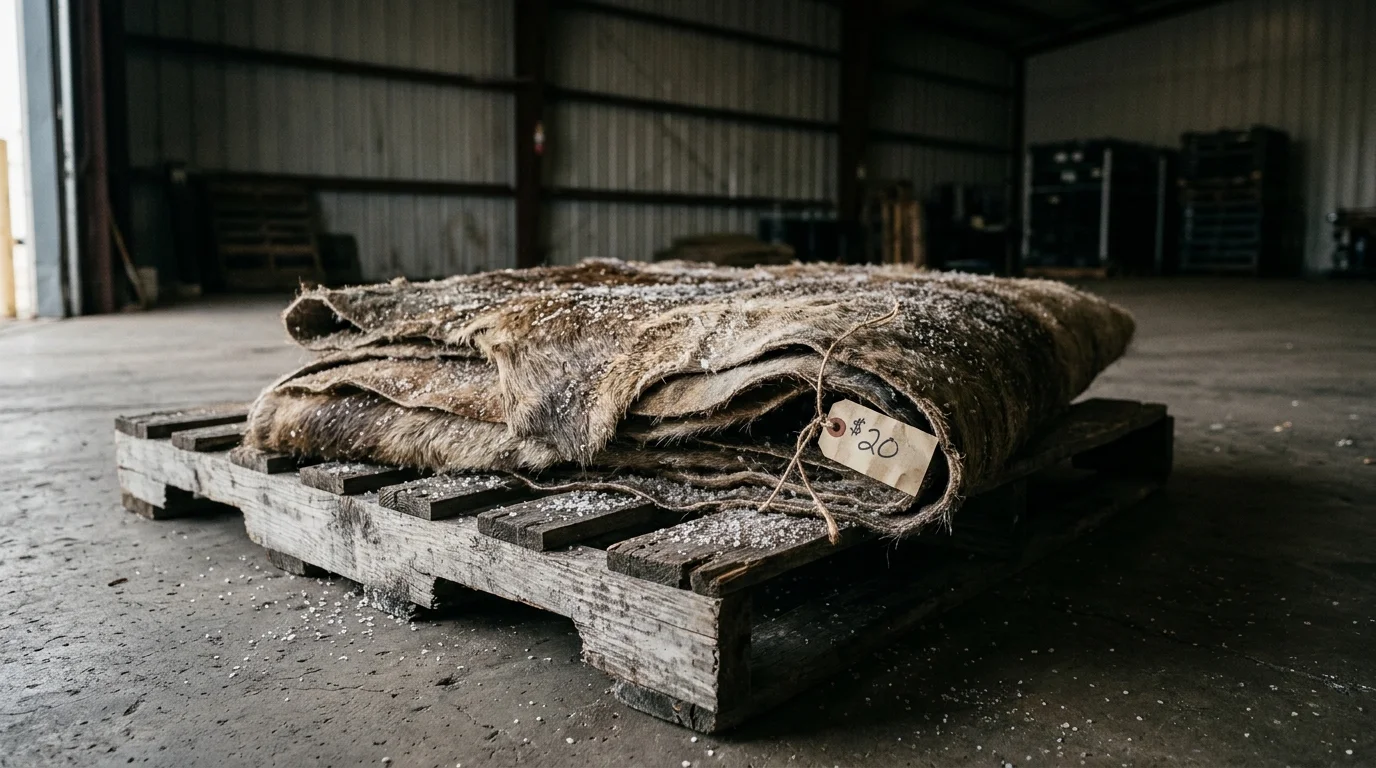
A 1,400-pound steer walked into a packing plant this summer carrying about $20 worth of skin. That figure comes from Tim Petry of North Dakota State University Extension, who reported in the July 2026 Angus Journal that steer hides were bringing $1.43 per hundredweight, or $20.02 a head. The same column put the animal’s tongue at $24.78.
The national herd is the smallest since 1951 and cattle prices are at records, while the hide has lost close to three-quarters of its value since the middle of the last decade.
A Herd Smaller Than Anything Since 1951
Peel expects prices to climb further
The USDA’s January count put the national herd at 86.2 million cattle and calves, the smallest since 1951, as Reuters reported through The Cattle Site. AgWeb described the herd as sitting at its smallest size in 75 years, and quoted Derrell Peel of Oklahoma State University on where prices were heading: “We’ve got record-high prices, and we’re going to see them push even higher for cattle and beef.”

Short supply should lift the price of everything an animal yields. Fewer steers means fewer tenderloins, fewer tongues, fewer pounds of tallow and fewer hides.
On Petry’s July figures, packer tallow brings $51.24 a head, helped by an energy market that buys tallow for renewable biofuels. The tongue brings $24.78. The hide brings $20.02.
What the Hide Used to Be Worth
From $74 to $20 in under a decade
For most of the modern meat trade, the hide was the prize among byproducts, the things a packer sells that aren’t beef. Petry says it plainly: hides were historically the most valuable byproduct, but have been overtaken by beef tallow and tongues. Hide values, he adds, kept falling in 2026, extending a decline that has run for several years.
Writing in Feedstuffs in July 2019, Peel put the 2013 to 2017 average for a butt-branded steer hide at $74.36 per piece. In the first half of 2019 that average had dropped to $34.46, though hides still made up 36.6 percent of total byproduct value.
Against this summer’s $20.02:
- Against the 2013-2017 average: down about 73 percent.
- Against the first half of 2019: down about 42 percent, from a level Peel was already describing as weak.
- Share of byproduct value: Petry puts total byproduct value at $198.52 a head, so the hide is now about 10 percent of it, against 36.6 percent in Peel’s 2019 tally.
- Per pound of animal: about 1.4 cents of hide for every pound of steer.
(Calculations from the published figures above. Petry’s and Peel’s tallies may not be built the same way, and hide grades and weights vary: a butt-branded steer and a heavy Texas steer can trade several dollars apart in the same week.)
2019, When Hides Started Going to Landfills
Four-dollar hides and a rancher in Altamont
The market has been here before. In August 2019 Bloomberg reported, in a story republished by SupplyChainBrain, that a branded cow hide went for as little as $4 the week of July 15, down from as much as $81 five years earlier. Hides were starting to go to landfills, the story said, while smaller leather processors went out of business. Lowell Carson of Double L Ranch in Altamont, New York, was giving some hides away and, according to the story, soon might have to send them to landfills.

That reporting is from 2019, and it describes cow hides, a lower grade than steers. What can be said is that the average steer hide is worth less now than in the first half of 2019, when those reports ran.
The causes named back then read like a list of things that happened to American closets. Bloomberg pointed to fast fashion and athleisure, clothing with no leather in it at all, and shoppers trading leather jackets and shoes for cheaper synthetics. Peel added weaker demand from luxury cars and footwear, both moving toward synthetic materials. Petry, this year, notes that many hides are exported to overseas customers to be processed into leather, and that synthetic substitutes have cut demand.
Car interiors are part of that picture. In July 2026 the pricing firm Fastmarkets described US automotive leather demand as stable but subdued, with domestic vehicle production trailing sales and weaker buying from China weighing on hides.
The Argument That Leather Pays for the Cow
McCartney’s co-product argument against the 2026 figures
The strongest case against leather goods is economic, and it is serious. The designer Stella McCartney has put it this way: “Leather isn’t a by-product – it’s the most important co-product of the meat industry.” Every dollar a packer earns from the skin, the reasoning goes, makes raising and killing the animal more profitable.
Her case doesn’t depend on the hide leading the list. Petry’s own column is titled “Byproduct Value Important to Cattle Prices,” and byproducts still return $198.52 a head; any revenue a packer counts on shapes what it can pay for cattle. Her line also covers leather everywhere, not just American steers, and plenty of the world’s leather comes from supply chains that look nothing like an American feedlot.
On US steers in 2026, though, “most important” is hard to defend. The hide now trails the tallow and the tongue and makes up about a tenth of byproduct value. Leather’s defenders have a sharper argument than they did in 2019: when the skin is worth this little, the live question is less whether leather drives slaughter and more whether those skins get tanned or thrown out.
Why a $20 Hide Does Not Make a Cheap Bridle Leather
Fourteen months in oak bark
A disclosure first: Marcellino NY makes and sells bridle leather goods, so this section touches its own business.

A raw hide is a perishable thing. Unless it is preserved quickly, bacteria start breaking it down, as the leather educator Tanner Leatherstein explains. Vegetable tanning in pits is slow by design. At most vegetable tanneries with pit systems, tanning takes around eight to 12 weeks, according to LeatherBiz.
J & FJ Baker in Devon, Britain’s last oak bark tannery, takes far longer. LeatherBiz and the Leathersellers’ Company both put it at 14 months to produce each piece of leather, and the Leathersellers note that this leather is made into bridles and saddles.
Set a $20 raw hide against eight weeks to more than a year of pit time. The reasoning is simple: a cheaper skin lowers the cost of the input that goes into the pit, not the cost of the weeks it spends there. How much any given tannery’s prices move is its own business, and none of the sources here put a number on it.
The Waste Nobody Has Counted Yet
The last count is from 2019
The Leather and Hide Council of America calculated that in 2019, 5.5 million hides from the US livestock industry failed to reach the leather value chain, around 16 percent of the total, according to LeatherBiz. No 2026 equivalent has been published. The steer hide average is lower than the year that count was made.
Petry’s column ends on trade: ongoing talks with the countries that buy American byproducts could affect demand. A deal that opened markets would give hides somewhere to go. A tariff fight would do the opposite.
Cattle are selling at record prices. The hide sells for $4.76 less than the tongue.
You Might Also Like
- Tariffs and Your Price Tags: What the New York Fed Found and What It Means for Buying Well
- American-Made Leather Briefcases: Four Makers and the Tanneries Behind Them
- Inside the Chouara Tannery in Fez: How Leather Is Made
Sources
- Tim Petry, “Byproduct Value Important to Cattle Prices,” Angus Journal Market Advisor, July 13, 2026: https://cd.angus.org/angus-media/angus-journal/2026/07/market-advisor
- Derrell Peel, “Weak hide values reducing cattle prices,” Feedstuffs, July 29, 2019: https://www.feedstuffs.com/market-news/weak-hide-values-reducing-cattle-prices
- “US cattle herd hits lowest level since 1951,” The Cattle Site (Reuters), February 2, 2026: https://www.thecattlesite.com/news/us-cattle-herd-hits-lowest-level-since-1951
- “U.S. Cattle Inventory Hits 75-Year Low at 86.2 Million Head,” AgWeb, January 30, 2026: https://www.agweb.com/news/livestock/beef/u-s-beef-herd-continues-downward-86-2-million-head
- “America’s Obsession With Beef Is Killing the Leather Industry,” Bloomberg via SupplyChainBrain, August 14, 2019: https://www.supplychainbrain.com/articles/30104-americas-obsession-with-beef-is-killing-the-leather-industry
- Fastmarkets, Hides, Leather and Industrial insights (July 21, 2026 item): https://www.fastmarkets.com/insights/category/agriculture/hides-leather-and-industrial/
- “Stella McCartney Sheds Light on Leather’s Dark Truth,” PETA Australia: https://www.peta.org.au/news/stella-mccartney-sheds-light-on-leathers-dark-truth/
- “Patience pays off,” LeatherBiz: https://leatherbiz.com/Features/161487
- The Leathersellers’ Company, “Where the oaks grow”: https://leathersellers.org/story/where-the-oaks-grow/
- “US hides are still going into landfill,” LeatherBiz, August 19, 2020: https://leatherbiz.com/News/155419
- Tanner Leatherstein, “Leather is an Upcycled Material”: https://www.tannerleatherstein.com/blogs/tanners-newsleather/leather-is-an-upcycled-material
For informational purposes only — consult a licensed attorney or financial advisor.


