
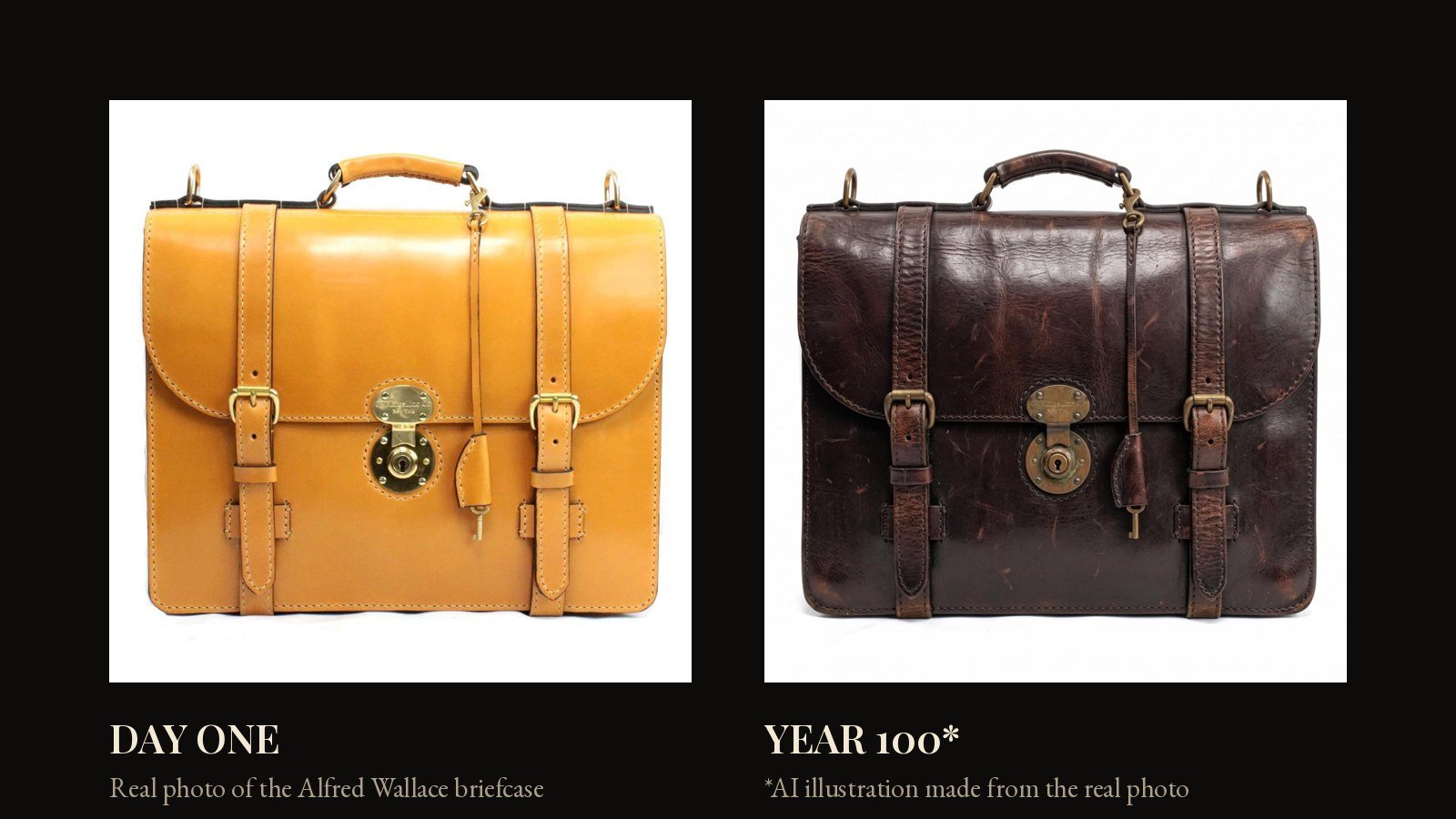
Disclosure: the day-one photograph is real. Every image of the briefcase at year 10, 25, 50 and 100, in the film and in this article, is an AI illustration made from that photograph. No Marcellino NY briefcase is a century old yet, so the later stages show a plausible direction and carry no measurements.
An Alfred Wallace in London tan leaves the bench the color of a new saddle, bright and even, close to orange under studio light. If it survives a century, very little of that color will remain. What happens in between is the subject of the film above, and of the sources gathered below.
What the briefcase is made of
Bridle leather is vegetable-tanned hide that a currier has dressed
Bridle leather starts at a tannery and finishes at a currier. A trade account in The Field describes curriers as the firms that take hides from tanners and put them through the dressing process. A Leathersellers’ Company profile of the Walsall currier J & E Sedgwick lists the steps: sorting, shaving to the required substance, drumming, setting and drying, then finishing by buffing, coloring, printing and greasing.
The Alfred Wallace is cut from English bridle leather. Its product page lists London Tan and Black in UK leather, with USA leather used depending on availability. The seams are traditionally hand saddle stitched, the handle is a bottom cross-stitch design built around a support bar, and the front carries double removable buckle straps. The page puts build time at up to six months.
Panel selection matters as much as the hide. In a video on a full hide, Joseph P. Marcellino describes the fibers as tightest at the butt, which is where the main parts of a bag come from, while the shoulder goes to smaller pieces and shows stretch marks.
The first year
Nothing happens at first, then the handle changes
Galen Leather, a leather goods maker, publishes a patina timeline for natural vegetable-tanned leather in daily use. In week one the piece still looks new. By month one the tone warms where hands land most: edges, corners, grips. At three months a light patina shows and the leather feels softer. By six months the raw color has moved toward honey-brown or deeper amber, and by the end of year one the patina is well established.
That is one maker’s estimate, not a standard.
Coach explains the mechanism: oils from the skin transfer to the leather, and the contact makes handles and straps look richer and slightly glossier. Sunlight can darken or lighten some leathers, and exposure to oxygen and humidity slowly changes the surface, often deepening the tone. On a Wallace, that points at the handle, the two buckle straps and the flap edge long before the back panel. The first weeks have their own account in an earlier journal piece on the break-in period of a bridle leather briefcase.

Years two to ten
Color deepens, creases settle, and light does the rest
For years two to five, the same timeline says the leather keeps deepening and softening, with the most-handled areas showing the richest color, fine micro-creasing and a soft sheen. Past five years it calls the result heirloom-level character. The phrase is the maker’s, and it describes a feeling more than a measurement.
Light and weather shape the rest. Carl Friedrik, another leather goods maker, notes that sunlight warms leather toward a golden tone while rain can leave water marks. Too much sun cuts the other way: Fibrenew, a leather restoration franchise, warns that prolonged direct exposure can cause uneven fading or cracking.
Popov Leather, a maker of small leather goods, lists the ingredients of patina: oils from the hands, dust, moisture in the air, indigo dye from jeans, sunlight, and scratches. It adds that wrinkles at the folds grow more pronounced with time. Its own comparison is a card holder, new beside the same one after a year and a half of daily use.
Brass ages on its own schedule. Walnut Studiolo describes brass as an alloy of copper and zinc that tarnishes, notes that leather can speed the reaction, and says the green verdigris it sometimes leaves on leather wipes off, with beeswax or conditioner as protection. Traveler’s Company, which makes solid brass pens, says the metal oxidizes and shifts to a deeper tone after years of use. The film shows the buckles and lock dulling in the same direction.
What slows aging and what speeds it
Use speeds it, care slows it
Galen Leather lists regular use, body oils and moisture from the hands, and sun as the accelerators. Cleaning, conditioning, sealing, keeping the piece out of direct sun and using it only occasionally slow the process. Occasional rather than daily use stretches the timeline by roughly two to three times, in that maker’s estimate.
Owners who want the change sooner have advice too. Ugmonk suggests setting natural vegetable-tanned leather in direct sunlight for several hours to speed the darkening, and Carl Friedrik recommends skipping the dust cover and using the piece often. Fibrenew draws the line the other way: it separates patina from wear and tear, and lists cracking from too much sun among the risks.
Popov Leather observes that owners tend to split into two camps: those who want patina as fast as possible and those who want the piece kept pristine. Neither camp is wrong; they are choosing different speeds.
Material sets the ceiling. The same source ranks undyed full-grain leather first for patina and says lower grades, such as genuine or bonded leather, patina less well or not at all.
Carl Friedrik argues that patina forms a protective layer on the leather, comparing it to the green coating on the Statue of Liberty, and still leaves the choice to the owner. That is a maker’s claim, offered without a test. How often a bridle leather briefcase needs feeding is covered in a separate piece on conditioning frequency.

Years 25, 50 and 100: where the evidence stops
The published timelines run out at about year five
Galen’s table ends at five years and beyond. Ugmonk, a design brand, says vegetable-tanned leather can last for generations with proper care, which is a seller’s statement and not a result. None of the sources found for this article followed one briefcase for a century.
One caveat covers the whole film. The timelines above describe natural, undyed vegetable-tanned leather, and Galen Leather names honey-brown as the six-month color of undyed hide. Coloring is one of the currier’s finishing steps, so a colored bridle leather such as London tan starts from a different place, and its road to deep brown will not match those tables month for month. No source consulted gave a timeline for colored bridle leather specifically.
The later frames in the film therefore carry the same few known forces forward: oils, light, air and wear. The rest is an illustrator’s choice. The caption at year 50, creases, scuffs and a second owner, is a scenario and not a finding.
For real decades, the journal has an account of an old English case filed under 1970 and what the years did to its bridle leather. A cost-per-year breakdown of a leather briefcase sits alongside it for anyone weighing a long life against a purchase price.

A century of supply is its own question
The firms that make the leather have histories of their own
The Walsall Leather Museum traces Walsall’s leather industry to the Middle Ages and counts about ninety leather companies in the town at the start of this century. J & E Sedgwick was set up there in 1900 by James and Emmanuel Sedgwick to supply the equestrian trade, according to Leather International’s report on the Clayton Leather Group, which bought the firm in 2015 and then saw it enter administration in October 2018. The Express & Star reported in 2019 that the Walsall business had been bought out by its biggest customer and was trading again.
A Marcellino NY video on Sedgwick’s tannery work says its maker had used that firm’s English bridle leather for years. The film’s narration says only a UK tannery for this piece, and this article names none.
The Alfred Wallace itself
A classic English briefcase style, built to order
The Alfred Wallace page describes a classic English briefcase style with an adjustable shoulder strap, a standard set of inside pockets and a back newspaper pocket. Each piece is built to order in New York, and the full range of bridle leather briefcases is at marcellinony.com.
You Might Also Like
- Original or Restored: A $495,000 Auction Gap and the Argument Over Patina
- Indoor Heat and Leather: Radiators, Dry Air and Where to Keep a Briefcase
- Inspecting a Used or Vintage Leather Briefcase Before Buying
Sources
- Galen Leather, Leather Patina
- Carl Friedrik, Leather patina
- Coach, What is Leather Patina
- Fibrenew, leather patina guide
- Popov Leather, why use a front pocket wallet (patina)
- Walnut Studiolo, brass tarnish and verdigris on leather
- Traveler’s Company, Enjoying the Aging Process of Leather and Brass
- Ugmonk, Leather Care
- The Field, Walsall leather
- Leathersellers’ Company, J & E Sedgwick apprentices
- Walsall Leather Museum, A history of the leather industry in Walsall (PDF)
- Leather International, Second Clayton Group tannery goes into administration
- Express & Star, Onwards and upwards for historic Walsall firm
- Marcellino NY, Alfred Wallace 2220b product page
- Marcellino NY, video on a full J.E. Sedgwick hide
- Marcellino NY, Leather Tanning at J E Sedgwick & Co (video)


