
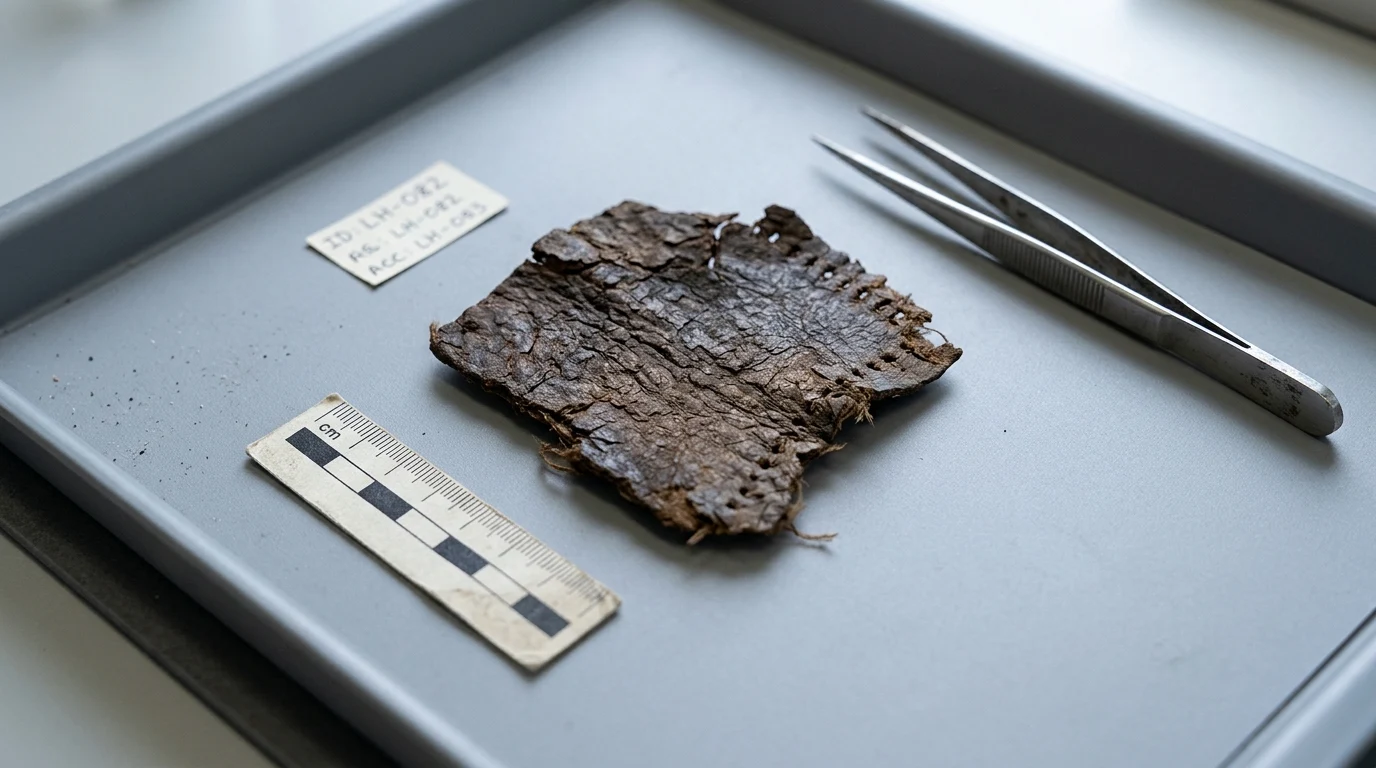
In 1857 a mining company went into a cave near Albuñol, in Granada, looking for galena. The workers came out with something else: partially mummified human remains, clothing, baskets and wooden objects, according to the paper published in PLOS One on November 4, 2026. One of those pieces, a scrap of tanned goat leather, has now given up its DNA.
The cave is Cueva de los Murciélagos, the cave of the bats. The leather is between roughly 7,250 and 7,000 years old by radiocarbon. And the goat it came from turns out to have relatives grazing in northern Spain today.
A hide that was worked, then worn
The research team, led by Jolijn Erven of University College Dublin according to Archaeology News Online, started with the object before the genome. Their abstract reports that archaeozoological analysis shows clear evidence of tanning and human modification of the skin. The photographs in the paper show both faces of the piece, perforations made by people, tanned edges, and a surface with traces of softening from use.
That last detail is the one a leatherworker notices. Softening from use is what a hide does when it is handled, folded and worn for long enough. Somebody carried this thing. Archaeology News Online reports that it was probably part of a garment or a protective covering, which is as far as the evidence goes; nobody knows exactly what it was.
The cave’s dry air did the rest. A 2023 study of the site in Science Advances describes its exceptional preservation of organic materials by desiccation, which is why the same cave produced basketry that has its own place in the record.
What the DNA said
The sample is called Murciélagos1. From it, the team recovered genome-wide data and found a domestic goat of European ancestry, not a wild ibex. Compared with modern goats, its closest match was the Bermeya breed from northern Spain. The paper reads that as genetic connectivity in goat herds from the Neolithic to present-day Iberia.
Its closest living match grazes a few hundred miles north of the cave.
There was other DNA on the leather too. The authors found fragments from humans, which they say likely reflect handling or wearing, and from a canid, which they put down to disturbance after burial. Archaeology News Online adds a finding the authors themselves hold loosely: no African ancestry turned up in the goat, which might suggest contact between Iberia and Africa came later than the Neolithic. The authors note it is one sample with incomplete data.
The paper also places Murciélagos1 among the oldest nuclear genome data from organic remains outside high-altitude and high-latitude regions. Cold places preserve DNA. Southern Spain is not one of them.

Two periods in one dry cave
Cueva de los Murciélagos already had a reputation before the goat. In 2023 a team led by Francisco Martínez-Sevilla dated its esparto grass basketry and sandals, and Hyperallergic’s report describes baskets about 9,500 years old among 76 organic artifacts first pulled out in the 19th century. The researchers called them the oldest basketry and sandals known in Europe.
The baskets belong to hunter-gatherers some 2,500 years before the goat leather, which comes from the Early Neolithic, when farmers and herders had arrived. Two different peoples used the same dry cave and left grass and hide behind, and the cave kept both. Any workshop that makes bags still holds the same pairing: a spool of thread, a stack of leather, and somebody deciding which goes where.
Older still: a stitch in Oregon
The leather from Spain is old. The sewing from Oregon is older.
Two small scraps of elk hide, joined by a cord of twisted fibers, came out of Cougar Mountain Cave in Oregon’s high desert in the 1950s. Science News reports they are about 12,400 years old, total just a few square centimeters, and stayed in private hands until recently. Smithsonian magazine adds that the collector kept them until his death in the 1980s, after which they went to the Favell Museum in Klamath Falls, and that the cord was made from plant fiber and animal hair.
The lead author, Richard Rosencrance of the University of Nevada, Reno, told Science News the hide is “definitely sewn, because we have cordage sewn into a hide that comes right out and goes into another piece of hide.” Bone needles turned up in the same cave. The study appeared in Science Advances in February 2026.
What it was for is still open. Archaeology magazine lists a coat, a moccasin or a tent as possibilities, and notes the dates fall in a stretch when the climate turned colder and drier, which would have made warm clothing necessary.

Oldest found is not oldest made
Headlines called the Oregon scraps the world’s oldest clothing. Rosencrance was more careful. Sewing in Eurasia goes back at least 45,000 years, he told NPR, and “what we have is just the oldest physical remains of something sewn.”
That is the honest shape of both stories. Leather rots. Thread rots faster. What survives depends less on when people started working hides than on where they happened to drop them: a desert rock shelter, a bat cave that stays dry, a bog, the permafrost.
So the record will keep moving backward as long as somebody keeps reopening old museum drawers. The Oregon scraps sat in a private collection for decades. The goat leather came out of the ground in 1857 and waited for a genetic method that did not exist until this century.
The part a maker recognizes
Strip away the radiocarbon and the genomes and there is a plain sequence in these two finds: take a skin, treat it so it stops rotting, cut it, make a hole, and pass a cord through the hole and into the next piece.
A saddle stitch through bridle leather is that same sequence with better thread and a harness needle. The Marcellino NY page on hand sewing leather with a saddle stitch describes two needles and one thread passing through each hole twice, once in each direction; the Oregon hide shows one cord through one hide into another, with bone needles lying in the same cave.
What nobody knows is who held the elk hide while the cord went through, or who wore the goat leather soft enough to leave traces of use. The human DNA on the Spanish piece is fragmentary, and the paper does not try to say whose it was.

Sources
- Erven et al., Genetic analysis of 7,000 year old preserved goat leather from Cueva de los Murciélagos (Albuñol, Spain), PLOS One, November 4, 2026: https://journals.plos.org/plosone/article?id=10.1371/journal.pone.0358468
- Archaeology News Online, 7,000-year-old goat leather from Spain reveals DNA link to modern Iberian goats: https://archaeologymag.com/2026/11/7000-year-old-goat-leather-from-spain-dna/
- Hyperallergic, Archaeologists say they’ve uncovered Europe’s oldest basketry: https://hyperallergic.com/archaeologists-say-theyve-uncovered-europes-oldest-basketry
- Science News, The world’s oldest piece of clothing might be an Ice Age–era hide from Oregon: https://www.sciencenews.org/article/oldest-clothing-ice-age-era-hide-oregon
- Smithsonian magazine, These 12,000-year-old scraps of elk hide may be the world’s oldest known examples of sewing: https://www.smithsonianmag.com/smart-news/these-12000-year-old-scraps-of-elk-hide-may-be-the-worlds-oldest-known-examaples-of-sewing-180988200/
- Martínez-Sevilla et al., The earliest basketry in southern Europe, Science Advances 2023: https://pmc.ncbi.nlm.nih.gov/articles/PMC10530072
- Rosencrance et al., Science Advances 12, eaec2916: https://www.science.org/doi/10.1126/sciadv.aec2916
- Archaeology magazine, Earliest evidence of sewn hide identified in Oregon cave: https://archaeology.org/news/2026/02/06/earliest-evidence-of-sewn-hide-identified-in-oregon-cave/
- NPR, Oregon cave holds 12,000-year-old sewn materials: https://www.npr.org/2026/02/23/nx-s1-5714550/oregon-cave-holds-12-000-year-old-sewn-materials
- Video: Marcellino NY Briefcase Maker on YouTube, https://www.youtube.com/watch?v=at-DaMcF4gI
You might also like
- The Saddle Stitch Explained: Hand-Sewing Leather Step by Step
- Inside the Chouara Tannery: Lime, Pigeon Droppings and a Month in the Vats
- Harness Needles and Sharp Needles
- Bridle Leather vs. Vegetable-Tanned: What the Difference Means in Your Hands


